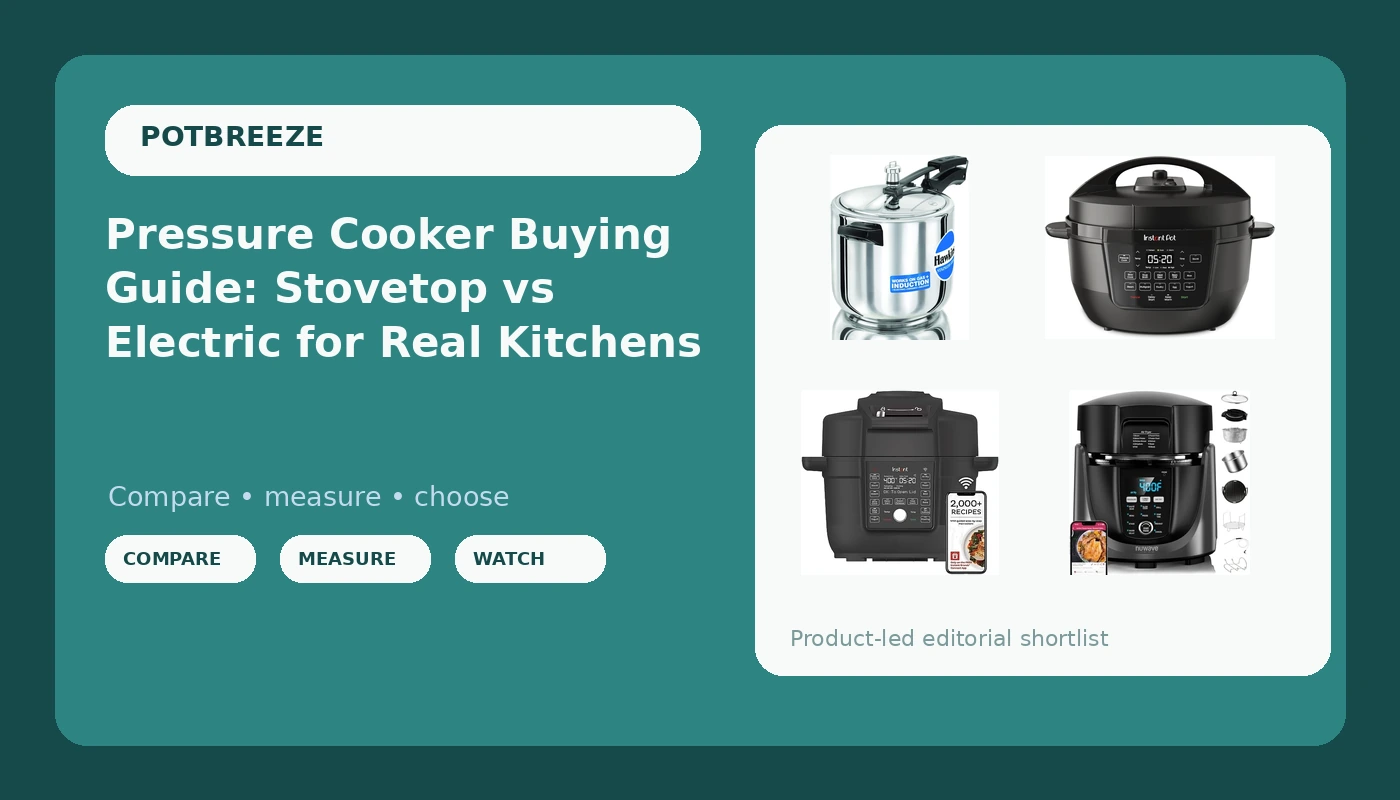
Pressure cookers have split into two families, and that split matters more than any feature list. On one side are stovetop cookers, the kind that sit on a burner and build pressure while you stand nearby. On the other are electric multi-cookers, which plug in, count themselves up to pressure, and then hold dinner warm until someone finally sits down. This pressure cooker buying guide walks through what separates the four models below, what the function counts on the box actually describe, and which trade-offs matter on a normal Tuesday. If you cook for a household and want fewer pans, the electric side usually wins. If you want a pot that will outlive three kitchen remodels, stovetop still has a case.
Related: Instant Pot vs Stovetop Pressure Cooker: Which One Belongs on Your Counter →
Quick answer
Buy an electric pressure cooker if you want set-and-forget timing, a keep-warm function, and one appliance that sautés, pressure cooks, and holds food until you are ready. Buy a stovetop cooker if you want a stainless pot with no control board, no display, and no electronics to fail. For most households cooking four to six servings several nights a week, a 6 to 7.5 quart electric model covers the widest range of meals. Choose a pressure cooker and air fryer combo only if you genuinely want crisping in the same footprint and are willing to give up some counter space.
4 useful options
| Model | Best fit | What stands out |
|---|---|---|
| Hawkins 6 Litre Inner Lid Pressure Cooker | Stovetop cooking on induction, gas, or coil | Stainless steel body, inner lid design, no electronics |
| Instant Pot Rio Wide 7.5 Qt 7-in-1 | Larger households and batch cooking | 7.5 quart capacity in a wider, lower body |
| InstantPot Duo Crisp Ultimate 6.5Qt 13-in-1 | Pressure cooking plus air frying, app control | 13-in-1 function set with Wi-Fi connectivity |
| Nuwave Duet Electric Pressure Cooker & Air Fryer Combo w/Probe | Combo cooking with temperature probing | Included probe plus a very large function count |
The stovetop traditionalist: Hawkins 6 Litre Inner Lid Pressure Cooker, Stainless Steel Cooker, Induction Cooker, Silver (Hss60), 6 Liter
A stovetop cooker puts every decision in your hands. You choose the burner setting, you decide when to lower the heat once pressure is reached, and you decide when to move the pot off the burner for a natural release. That control is exactly why some cooks prefer it: nothing is automated, so nothing is hidden. The trade-off is attention. You cannot walk away for forty minutes, and there is no keep-warm function holding dinner at temperature when the family runs late. If you want the appliance to be a tool rather than a device, this is the shape of that choice. Buyers should also confirm the gasket or sealing ring for their specific model is available as a spare part, because a stovetop cooker without a replacement gasket becomes a very sturdy stockpot.
The family-size electric: Instant Pot Rio Wide 7.5 Qt 7-in-1 Electric Pressure Cooker, WhisperQuiet
Capacity is the first number to get right, and 7.5 quarts changes what a single batch can do. A pot this size handles a whole chicken, a large pot of beans, or enough chili that leftovers exist on purpose rather than by accident. The wide, lower shape also matters for anything you want to brown before pressure cooking, because a broader base gives more food direct contact with the hot surface instead of stacking it up the walls. The catch is the fill line. Pressure cookers must never be filled past the maximum mark, and foods that foam or expand, like beans, grains, and pasta, need more headroom than a stew does. A bigger pot does not mean you can fill it to the brim, so read the markings on the inner pot before the first cook. The model name also points to quieter operation, which matters in an open kitchen where the cooker runs while people are talking.
The connected combo: InstantPot Duo Crisp Ultimate 6.5Qt 13-in-1 Pressure Cooker Air Fryer Wifi
This is the option for someone who wants a crisp finish without buying a second appliance. Pressure cooking gets food tender and fast; air frying then puts color and texture on the surface. Doing both in one unit saves counter space and saves the transfer step where a sheet pan and a hot oven get involved. The honest trade-off is that a combo appliance is two appliances sharing one body. It does not have the basket volume of a dedicated air fryer, and its air frying performance depends on how much food you crowd into the basket at once. Wi-Fi adds another layer: remote start and monitoring are convenient, but they are only worth paying for if you actually use an app while cooking. If you rarely reach for your phone in the kitchen, the connectivity is dead weight.
The probe combo: Nuwave Duet Electric Pressure Cooker & Air Fryer Combo w/Probe, 450-in-1
A probe is the one feature on this list that changes how you cook rather than how the machine is marketed. Instead of guessing whether a roast is done, you cook to an internal temperature, which is the same standard a restaurant line uses. That is genuinely useful for chicken, pork shoulder, and any cut where dry and safe are two different finish lines. The very large function count is a different story. Four hundred and fifty presets sounds like flexibility, but most of them are combinations of time, temperature, and mode that you could set manually in a few seconds. Treat the count as a menu of suggestions, not a measure of capability, and judge the unit on its pressure performance, its air frying basket, and whether replacement parts are easy to find.
Prices and availability may change. Product images, names, and retailer links are matched to verified listings. No current price, rating, stock status, or measured result is stated here without current evidence.
How pressure cooking actually works
A pressure cooker is a sealed vessel. As liquid inside turns to steam, that steam cannot escape, so the internal pressure rises, and rising pressure pushes the boiling point of water upward. Food cooks in a hotter, wetter environment than it would in an open pot, which is why a stew that takes three hours on the stove can finish in well under one. The seal is the whole mechanism. That is why the silicone gasket, usually called the sealing ring, is the single most important wear part in any pressure cooker. It hardens, it stretches, and it absorbs the smell of every curry and chili it has ever cooked. A ring that no longer seals means the cooker never reaches pressure, no matter how good the electronics are.
Releasing pressure is the second half of the technique. Natural release means you turn off the heat and let the pressure fall on its own, which keeps food in that hot environment a little longer and is the safer route for large cuts of meat and for anything with a lot of liquid. Quick release means you vent the steam deliberately, which stops cooking fast and is the right call for vegetables and delicate foods. Neither method is better in general. They produce different results, and the recipe should tell you which one it expects.
What function counts really mean
The numbers on the box, whether 7-in-1, 13-in-1, or 450-in-1, are naming conventions rather than standards. There is no body that certifies what counts as a function, and manufacturers count differently. One brand might list rice, porridge, soup, and steam as four separate functions; another folds them into one program with adjustable time. The result is that a 13-in-1 and a 450-in-1 can cook the same dinner in the same amount of time, because both ultimately control the same two variables: pressure and duration.
What actually separates one electric cooker from another is less glamorous. How hot does sauté mode get, and does it hold that heat without scorching? How quickly does the unit come to pressure, and does it hold steady once there? How easy is the lid to seat and lock? Can you buy a replacement sealing ring and inner pot two years from now? Those questions decide whether a cooker earns counter space. Answer them before you compare preset lists.
- Count the servings you actually cook. A 6 quart suits two to four people; a 7.5 quart suits a family with leftovers in mind.
- Decide whether you will stand at the stove. Stovetop cookers reward attention; electric cookers reward walking away.
- Decide whether you need crisping. If browning under a broiler already works for you, a combo may be unnecessary.
- Check the parts. Confirm a sealing ring and inner pot are available for the model before you commit.
- Measure the counter and the cabinet. A wide 7.5 quart body and a combo unit with two lids take up more room than a tall 6 quart.
Practical guidance before you buy
- Respect the maximum fill line on every cook, and give beans, grains, and pasta extra headroom because they foam and expand.
- Never pressure cook with less liquid than the manual requires. The cooker needs steam to build pressure.
- Use natural release for roasts, dried beans, and anything with a lot of liquid, and quick release for vegetables and seafood.
- Sauté in batches rather than piling food into the pot. Crowding steams meat instead of browning it, and that is a pan problem, not a cooker problem.
- Buy a spare sealing ring when you buy the cooker, and store it away from the lid so it keeps its shape.
Which option should you choose?
Choose the Hawkins 6 Litre Inner Lid Pressure Cooker when you want a stovetop pot with no electronics, you cook on induction or gas, and you are comfortable managing heat and release yourself. Choose the Instant Pot Rio Wide 7.5 Qt 7-in-1 Electric Pressure Cooker when you cook for a larger household, want a wide base for browning, and want pressure cooking with keep-warm convenience. Choose the InstantPot Duo Crisp Ultimate 6.5Qt 13-in-1 Pressure Cooker Air Fryer Wifi when you want crisping and pressure cooking in one unit and you will actually use app control. Choose the Nuwave Duet Electric Pressure Cooker & Air Fryer Combo w/Probe when cooking to an internal temperature matters to you and you want the probe built into the purchase.
One caveat applies to all four. Nothing here is a measurement of how these cookers perform in your kitchen. Capacity, function lists, and included accessories come from the product listings; sauté strength, come-to-pressure time, and noise level vary by model and by what you are cooking. Treat the function count as the least important number in the comparison and the sealing ring as the most important wear item.
The bottom line
The right pressure cooker is the one that matches how you actually cook. If you want a machine that sautés, pressure cooks, and holds dinner warm while the household assembles, an electric 7-in-1 like the Rio Wide covers the most weeknights. If you want crisping without a second appliance, the Duo Crisp Ultimate or the Nuwave Duet earns its footprint, and the Duet's probe is the more useful extra of the two. If you want a stainless pot with no software, no presets, and a lifespan measured in decades, the Hawkins stovetop cooker is the honest answer. Pick the category first, then the size, then the extras. The extras are the easiest part to get wrong.