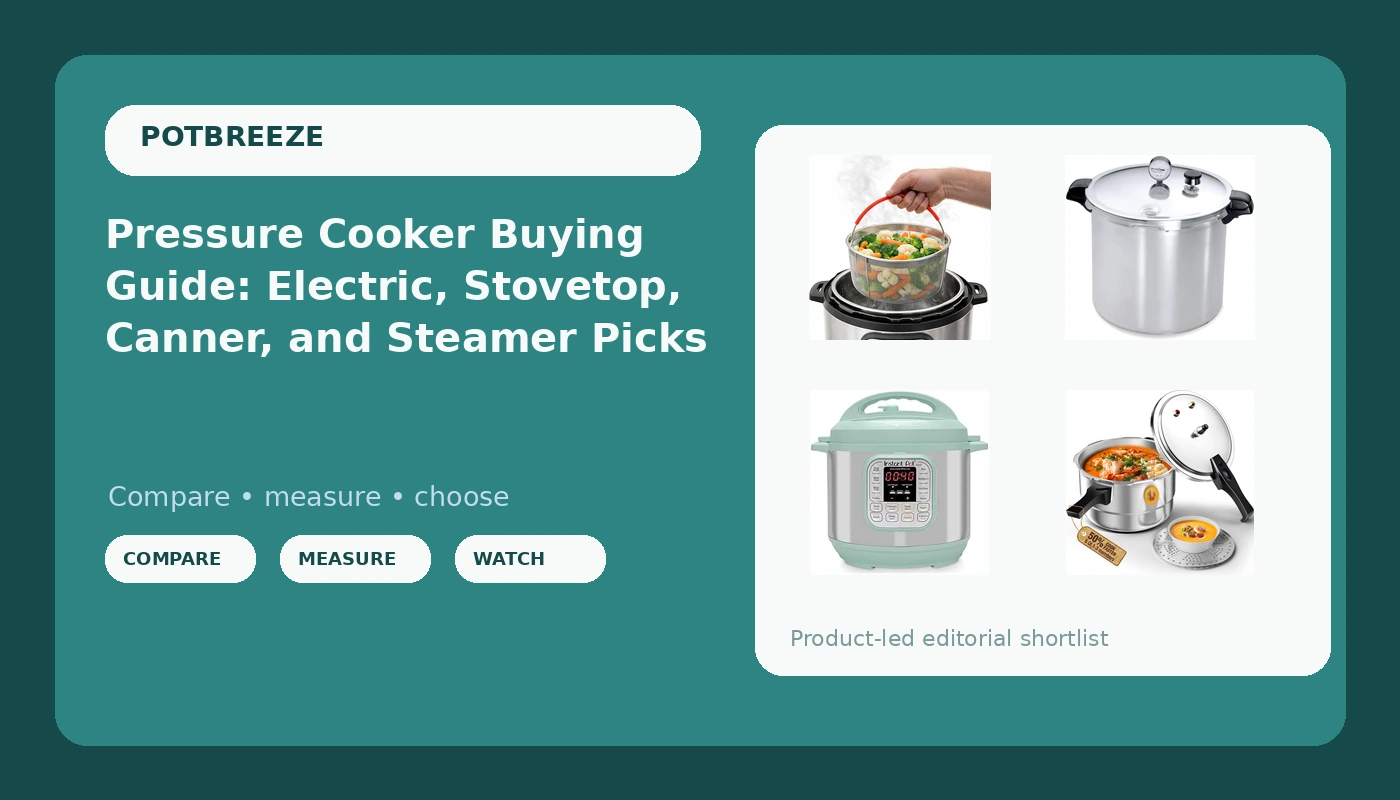
Pressure cooking squeezes a long braise into a weeknight window, but "pressure cooker" describes several different tools that happen to share a locking lid. There is the countertop electric multi-cooker with a keypad and a keep-warm mode. There is the stovetop pot that sits on a burner and hisses while you watch the regulator. There is the tall canner built to hold jars, not dinner. And there is the small insert that makes any of them steam vegetables without a colander. This pressure cooker buying guide covers four specific options, what each one is actually for, and where the trade-offs show up after the first enthusiastic week.
Related: Electric vs. Stovetop Pressure Cookers: Which One Fits Your Kitchen? →
Quick answer
Match the tool to the job before you match it to a feature list. If you want one countertop appliance that pressure cooks, slow cooks, makes rice, steams, sautés, makes yogurt, and keeps food warm, look at a 6-quart electric multi-cooker with one-touch programs. If you cook on a gas or induction range and prefer to control the heat yourself, look at a 6-quart aluminum stovetop cooker with a release valve and a removable steaming rack. If your goal is putting up jars of tomatoes, jam, or stock, you need a 23-quart pressure canner, which is a different class of equipment with a different job. And if you already own a 6-quart cooker and only want better steaming, a basket insert costs far less than a new appliance.
Four useful options
| Model | Best fit | What stands out |
|---|---|---|
| Instant Pot Duo 7-in-1 Electric Pressure Cooker, Slow Cooker, Rice Cooker, Steamer, Saute, Yogurt Maker, and Warmer, 6 Quart, Teal, 14 One-Touch Programs | One countertop appliance for a household that cooks most nights | Listed as a 7-in-1 electric multi-cooker with 14 one-touch programs in a 6-quart teal body |
| WantJoin 6 Qt Aluminum Pressure Cooker - Gas & Induction Stovetop Compatible Pressure Pot with Release Valve, Multiple Safety Features and Removable Steaming Rack | Cooking on a gas or induction range with manual heat control | Aluminum 6-quart stovetop body, release valve, listed safety features, removable steaming rack |
| Presto 01784 23-Quart Induction Compatible Pressure Canner | Canning jars and very large batches | 23-quart capacity with an induction compatible base |
| Salbree Steamer Basket for 6qt Instant Pot and Many Other Pressure Cookers | Steaming in a cooker you already own | Insert sized for 6-quart Instant Pot models and many other pressure cookers |
The countertop multi-cooker: Instant Pot Duo 7-in-1 Electric Pressure Cooker
The trade-off with any electric multi-cooker is that everything happens inside one sealed insert sitting on your counter. You gain repeatability and a keep-warm mode that holds dinner until people actually sit down. You give up burner control and the freedom to move the pot to a different heat source. The function that decides how the appliance feels day to day is sauté, because a sauté mode hot enough to brown means you are not dirtying a skillet on the side. The second thing to check is the sealing ring, the silicone gasket that holds pressure and absorbs the smell of every curry you cook in it. If a replacement ring is easy to find, the cooker has a long life ahead of it.
The stovetop cooker: WantJoin 6 Qt Aluminum Pressure Cooker
A stovetop cooker hands heat control back to you. You bring it up on the burner, wait for the pressure indicator or regulator to signal that pressure has built, then drop the flame to hold it steady for the cook time. That manual control is exactly why some cooks prefer the format for stocks, beans, and anything where they want to adjust on the fly. The trade-off is attention. A stovetop cooker is not set-and-forget, the regulator makes noise, and the timing is yours to manage rather than the appliance's. The induction compatibility listed on this model matters if your range is induction, and it is worth confirming your cooktop type before buying any stovetop pot.
The pressure canner: Presto 01784 23-Quart Induction Compatible Pressure Canner
This is the category most shoppers blur together, and it is worth separating. A pressure cooker cooks food for tonight. A pressure canner processes sealed jars for shelf storage, which is why it is built tall and wide: jars need to stand upright with room for steam to move around them. That 23-quart capacity is a benefit during tomato season and a nuisance if what you actually wanted was a quick pot of beans. Buying a canner for weeknight dinners, or trying to can in a small cooker, is a mismatch in both directions. If you are not putting up jars, this is not the purchase you are looking for.
The small upgrade: Salbree Steamer Basket for 6qt Instant Pot and Many Other Pressure Cookers
An insert is the least expensive way to change how a cooker behaves, and it is also the one where fit matters most. The listing is written around 6-quart Instant Pot models and other pressure cookers of similar size, so measure your insert before ordering if your pot is a different capacity or an unusual shape. A basket that sits too high can interfere with the lid locking, and one that sits too low leaves food sitting in liquid. When it fits, though, it turns a pressure cooker into a steamer for broccoli, tamales, and fish without hauling out a separate pot.
Prices and availability may change. Product images, names, and retailer links are matched to verified listings. No current price, rating, stock status, or measured result is stated here without current evidence.
Electric, stovetop, and canner: what actually changes
All three formats raise the boiling point of water by trapping steam under pressure, which is why they all cook faster than an open pot. What changes is who controls the heat and what the vessel is built to hold.
With an electric multi-cooker, the heating element and the thermostat live in the base. You pick a program, the appliance comes to pressure, counts down the cook time, and then usually shifts into a keep-warm mode. The benefit is repeatability: the same setting produces the same result on a Tuesday as it does on a Sunday. The costs are an outlet, a counter footprint, and the fact that the insert stays put. Browning happens in the same insert through the sauté function, and how hot that function actually gets is the difference between a one-pot dinner and a one-pot dinner plus a frying pan to wash.
A stovetop cooker gives heat control back to the cook. You manage the burner, watch the pressure signal, and adjust the flame to hold pressure for the duration. Cooks who like to taste and adjust mid-cook tend to prefer this. The cost is attention and a learning curve. The regulator is audible, the pot needs a matching cooktop, and both the WantJoin cooker and the Presto canner listed above are described as induction compatible, which is a detail worth verifying against your own range.
A pressure canner is a third category with a different purpose. The 23-quart Presto is built for processing sealed jars at a controlled pressure, which is why the volume is so much larger than a cooking pot. Jars need to stand upright with space around them for steam to circulate, and a 6-quart cooker simply cannot provide that.
How to narrow it down in five steps
- Count the people you feed on a normal weeknight. A 6-quart cooker suits most family cooking; a 23-quart canner is about jars and volume, not portions.
- Decide where the pot will live. Countertop electric means an outlet and permanent counter space. Stovetop means a burner and your attention during the cook.
- Separate cooking from preserving. If you are not processing sealed jars, cross the canner off the list and put the money toward a better cooking pot.
- Check your cooktop. Gas and induction compatibility are listed on the stovetop options here, and induction is a real constraint if that is what you cook on.
- Ask whether you need an appliance at all. If you already own a 6-quart cooker and the only gap is steaming, a basket insert closes it for far less.
What to check before you buy
- Sealing ring availability. The silicone gasket is a wear item that holds pressure and absorbs odors. If replacements are hard to find, the cooker has a short useful life.
- Sauté behavior. On an electric model, this function decides whether you brown in the pot or dirty a second pan.
- Steam release path. Look at where the vent points, because a vent aimed at your upper cabinets will make you dread the quick release.
- Capacity math. Most recipes and accessory listings are written around 6 quarts, so matching that size keeps both recipes and inserts compatible.
- Cooktop and counter fit. Measure the space, confirm the base works on your range, and check that the lid clears your cabinets when open.
Which option should you choose?
Choose the Instant Pot Duo 7-in-1 Electric Pressure Cooker when you want one countertop appliance that handles pressure cooking, slow cooking, rice, steaming, sauté, yogurt, and warming with one-touch programs. Choose the WantJoin 6 Qt Aluminum Pressure Cooker when you cook on a gas or induction range and want to control the heat yourself with a traditional stovetop pot. Choose the Presto 01784 23-Quart Induction Compatible Pressure Canner when your goal is putting up jars of tomatoes, jam, or stock and you need the volume to do it. Choose the Salbree Steamer Basket when you already own a 6-quart cooker and only want better steaming.
One caveat applies to all four: the details here come from the product listings, not from a lab bench, and the features that matter most to you may not be the ones the listing leads with. Read the current product page, confirm capacity and compatibility against your own kitchen, and check that consumable parts such as sealing rings can be reordered before you commit.
The bottom line
The right pressure cooker is the one that matches how you already cook, not the one with the longest feature list. An electric 6-quart multi-cooker covers the widest range of weeknight jobs, a stovetop pot rewards cooks who want manual control, a 23-quart canner exists for preserving rather than dinner, and a steamer basket is the cheap fix when the appliance you own is already fine. Pick the format first, then the model, and the rest of the decision gets much shorter.