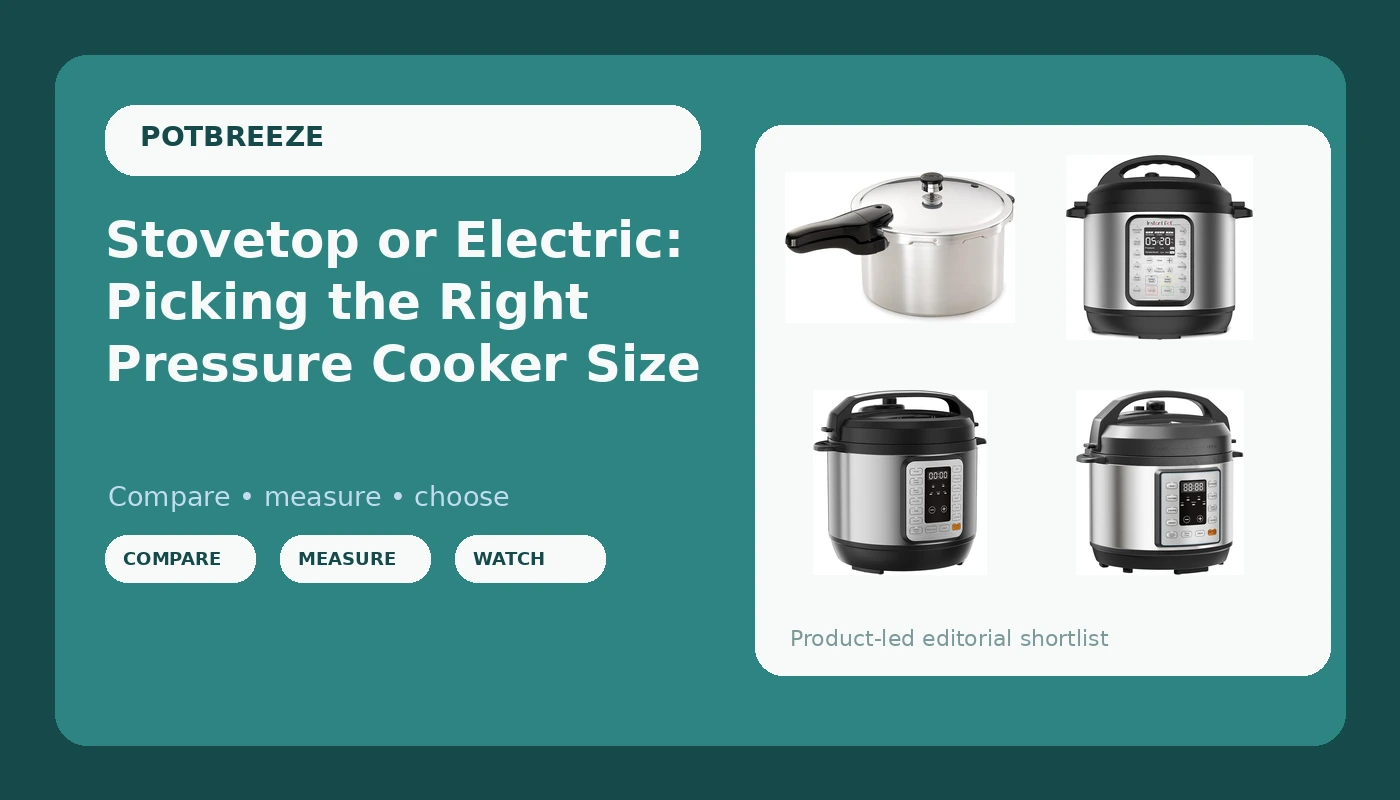
An electric pressure cooker is a time machine with a power cord, and the pot you pick decides whether weeknight dinner takes forty minutes or two hours. The trouble is that this category hides its real differences behind feature counts. A 16-in-1 label and a 10-in-1 label can describe two machines that hold roughly the same amount of chili, while a stovetop cooker with no buttons at all can outlast both of them. What actually separates these appliances is capacity, how they build and release pressure, what the inner pot is made of, and whether the parts that wear out can be replaced. This guide walks through four widely sold pressure cookers, from a 3-quart electric model to an 8-quart aluminum stovetop cooker, and explains which one fits which kitchen.
Related: Electric Pressure Cooker Sizes: 3-Quart vs 6-Quart vs 8-Quart →
Quick answer
Match the cooker to your headcount and your heat source. A 3-quart electric pressure cooker covers one or two people, rice, and small batches of stew. A 6-quart electric model fits most families of four and is the most flexible starting point. An 8-quart cooker handles stock, large cuts, and batch cooking, whether it is electric or stovetop. Electric models run their own timer and pressure cycle and typically add sauté, slow cook, and keep warm programs. Stovetop cookers are simpler hardware: no electronics, no presets, and you control both the heat and the clock.
Four useful options
| Model | Best fit | What stands out |
|---|---|---|
| Instant Pot Duo Plus 6 Qt 9-in-1 Electric Pressure Cooker | Households cooking for three to five | 6-quart stainless steel inner pot with a 9-in-1 programmable function set |
| Sweetcrispy 16-in-1 Electric Pressure Cooker 8QT | Big batches and weekly meal prep | 8-quart body with a ceramic inner pot and a bundled recipe book |
| NEWBULIG 10-in-1 Electric Pressure Cooker, 3 Quart | Small kitchens, singles, and side dishes | Compact 3-quart programmable cooker with both a stainless steel pot and a ceramic inner pot |
| Presto 01282 8-Quart Aluminum Pressure Cooker | Stovetop cooks with a range they can adjust | Aluminum 8-quart stovetop cooker with no cords, electronics, or preset programs |
The family-size default: Instant Pot Duo Plus 6 Qt 9-in-1 Electric Pressure Cooker
Six quarts is the size that solves the most weeknight problems without becoming a storage problem. It holds a whole chicken, a batch of beans, or four quarts of chili with headroom for the steam, and it still fits under most upper cabinets when the lid is off. The stainless steel inner pot is the practical detail here: no coating to scratch, and you can go at it with a metal spoon or a scrubber when something sticks. The trade-off is that stainless is slower to release food than a nonstick surface, so a long simmer of tomato or beans will leave more to soak. If your household is two adults and a toddler, this capacity can feel like more pot than you need on a Tuesday, but it is the size that scales to holidays and leftovers.
The big-batch pick: Sweetcrispy 16-in-1 Electric Pressure Cooker 8QT
Eight quarts is where pressure cooking stops being about one dinner and starts being about the next three. This is the size for a pot of stock from a picked-over roast chicken, a double batch of pulled pork, or a Sunday of meal prep that fills containers for the week. The ceramic inner pot is the part to think about: it releases sticky, starchy food more easily than bare stainless, which matters if you cook rice and porridge often, but it needs wooden or silicone utensils and gentler washing. The preset count deserves a skeptical eye. A long function list usually means several buttons that all pressure cook at the same setting, so read the manual and find the two or three programs you will actually press. The extra quart also means a longer run to pressure and a heavier pot to lift to the sink.
The small-batch pick: NEWBULIG 10-in-1 Electric Pressure Cooker, 3 Quart
Three quarts is the honest size for a small household, and it is underrated for a big one. It is the right pot for a batch of rice that will not turn into a week of rice, for steel-cut oats, for a single pound of dried beans, and for reheating a frozen quart of soup straight from the freezer. Two inner pots in the box is the detail that stands out here: stainless for anything acidic or heavily spiced, ceramic for rice and sticky grains, with no need to buy a second pot later. The obvious limitation is the ceiling. You cannot fit a whole chicken, you cannot pressure cook for five people in one go, and a big stock batch is out. If you already own a larger cooker, this works as the everyday pot for sides and small meals rather than a replacement for it.
The stovetop classic: Presto 01282 8-Quart Aluminum Pressure Cooker
A stovetop cooker is not a downgrade, it is a different job. You bring it up to pressure over a burner, then turn the heat down and watch the regulator rock for the length of the cook. That means attention: you cannot walk away for an hour the way you can with a programmable electric model, and you have to learn your own stove's settings. In exchange you get a pot with no control board, no lid sensor, and no software, plus faster heating because the burner is doing the work. The learning curve is real, and the noise of a rocking regulator unsettles first-timers. It also needs a burner you can actually modulate, so a glass-top or induction range with an aluminum body may not be the right pairing.
Prices and availability may change. Product images, names, and retailer links are matched to verified listings. No current price, rating, stock status, or measured result is stated here without current evidence.
Electric versus stovetop: what actually changes at dinner
The difference is not quality, it is where the control lives. An electric pressure cooker owns the pressure cycle: you choose a program, it heats, seals, counts down, and then holds food warm until you open it. That is what makes it a weeknight tool for someone cooking for five. A stovetop cooker hands that control back to you. You decide when the heat comes down, you decide how long the pot rocks, and you decide whether pressure drops on its own or gets released quickly.
That distinction shapes the food. Natural release, where you let the pressure fall by itself, keeps meat tender and keeps starchy liquids from foaming up through the valve. A quick release is faster but can toughen a roast and spatter. Electric models let you mostly forget the pot during that window; stovetop cookers ask you to stay nearby and pay attention. Neither is more correct, but one fits an interrupted evening and the other fits a cook who wants their hands on every stage.
Capacity, programs, and inner pots
Capacity is the first filter, because a pot that is too full will not come to pressure properly and a pot that is too empty wastes time heating. Manufacturers usually specify a maximum fill line, often around two-thirds for liquids and less for foods that expand or foam. Function counts are the second filter, and they are marketing as much as engineering. Ten or sixteen "functions" often share a handful of underlying pressure and temperature settings.
Inner pot material is the third filter, and the one people notice last. Stainless steel is durable and coating-free but releases sticky food less easily. Ceramic and nonstick surfaces are easier to clean and gentler on rice, but they scratch and wear, so utensil choice matters. Whichever you choose, check that the sealing ring and other wear parts can be bought separately, because a cooker whose gasket cannot be replaced has a limited life no matter how many presets it lists.
- Count the people you actually feed on a normal weeknight, not at Thanksgiving.
- Measure your cabinet clearance and counter space before choosing an 8-quart body.
- Decide whether you will stand at the stove or walk away, since that determines stovetop versus electric.
- Look at the inner pot material and how you cook: rice and porridge favor ceramic, acidic braises favor stainless.
- Confirm that the sealing ring and other wear parts are sold separately before you commit.
Practical guidance
- Fill below the marked maximum line, and lower still for rice, beans, and anything that foams.
- Budget extra time for the pot to come to pressure and for natural release, not just the programmed cook time.
- Cook one familiar recipe first, such as a basic chili or a batch of rice, so you learn the machine before a dinner depends on it.
- Keep a spare sealing ring on hand and replace it when it stretches, smells strongly, or stops holding pressure.
- Never quick release a pot of stew, soup, or grains without checking the manual; some foods spray through the valve.
- For stovetop models, stay in the kitchen until you know how your burner behaves at pressure.
Which option should you choose?
Choose the Instant Pot Duo Plus 6 Qt 9-in-1 Electric Pressure Cooker when you cook for three to five people, want the timer to handle the pressure cycle, and prefer a stainless inner pot with no coating. Choose the Sweetcrispy 16-in-1 Electric Pressure Cooker 8QT when capacity is the priority, you batch cook for the week, or you want a ceramic inner pot for rice and a recipe book to start from. Choose the NEWBULIG 10-in-1 Electric Pressure Cooker, 3 Quart when you cook for one or two, want small batches of rice and stew, and like having both a stainless and a ceramic pot in the box. Choose the Presto 01282 8-Quart Aluminum Pressure Cooker when you already know how to work a stovetop cooker, want an 8-quart pot with no electronics, and have a burner you can adjust with confidence.
Capacity and function counts come from the manufacturer listings. The number of programs a cooker advertises does not tell you how well any single program performs, and a stovetop cooker's results depend heavily on your range and your attention.
The bottom line
Size first, heat source second, features third. A 3-quart electric cooker is the honest choice for one or two people; a 6-quart electric model is the flexible middle that handles most family dinners; an 8-quart cooker, electric or stovetop, is for stock, large cuts, and meal prep. Electric models trade some control for convenience and a keep-warm function that makes dinner land when you do. Stovetop models trade convenience for simpler hardware and faster heating. Pick the capacity that matches your table, confirm that the sealing ring can be replaced, and ignore the function count until you have decided those two things.