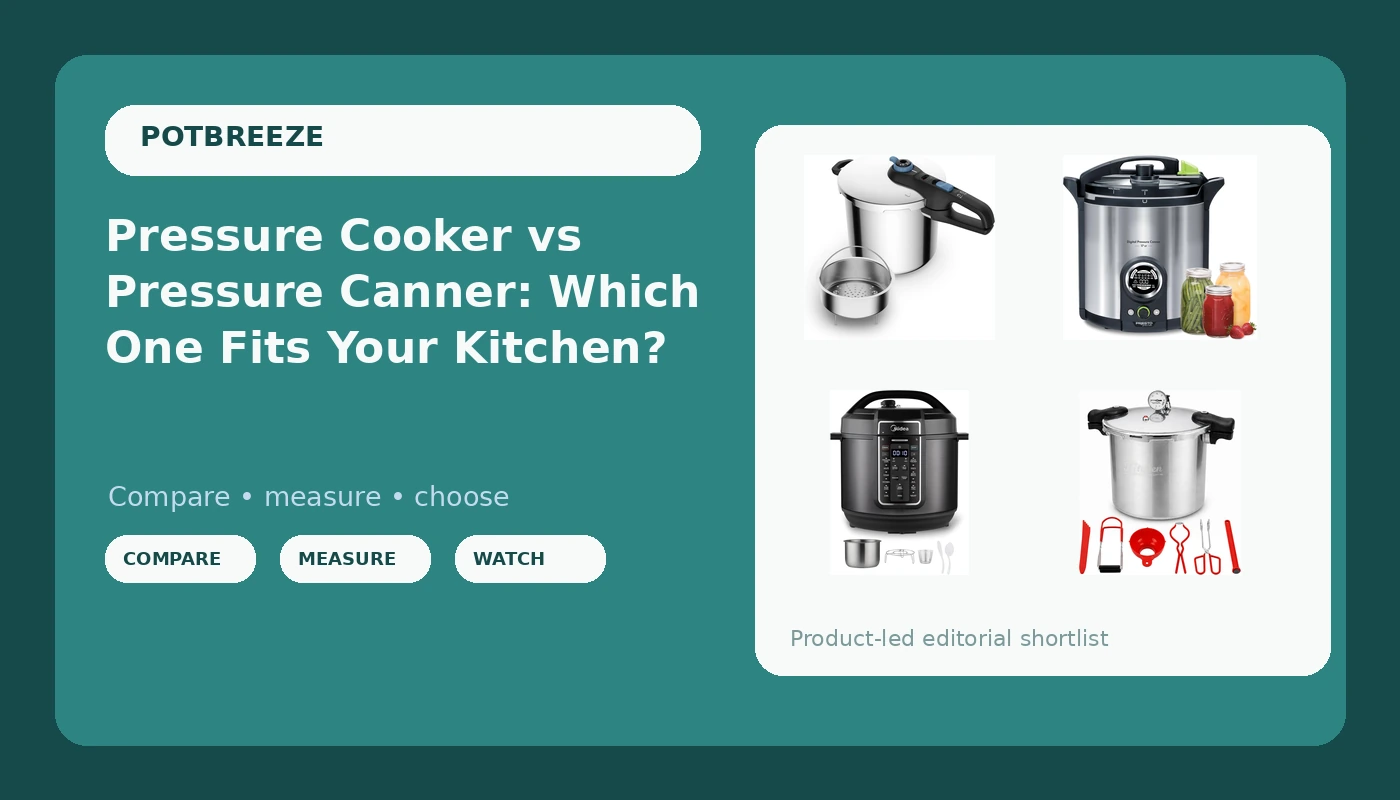
Choosing between a pressure cooker and a pressure canner comes down to one question: are you cooking dinner tonight, or are you putting food on a shelf for January? The pressure cooker vs pressure canner decision trips up a lot of shoppers because the two appliances look alike. Both have a locking lid, both build internal pressure, both show up in the same search results. They are not interchangeable. A cooker is built to get a meal done fast and then come apart for cleaning. A canner is built to hold a steady, verifiable pressure long enough to make low-acid food shelf stable, and it is sized so that jars actually fit inside it.
This explainer covers four options across that whole range: two cookers for weeknight food and two canners for people who garden, hunt, or split a hog every fall. Everything here comes from the manufacturer specifications on the listings, not from a lab bench or a borrowed claim.
Related: How to Tell When a Pressure Cooker Sealing Ring Needs Replacing →
Quick answer
If your goal is faster dinners, buy a pressure cooker. If your goal is preserving low-acid food in jars at home, buy a pressure canner. Electric multi-cookers such as the Midea 12-in-1 handle beans, stews, rice, and yogurt with a push of a button, while stovetop units such as the T-Fal Secure Trendy give you a wider pot and a burner you control directly. Canners, including the 24 Quart Pressure Canner Kit and the Presto 02152, are the correct tool for canning vegetables, meat, and stock, and they can double as very large cookers. Do not water-bath can green beans, and do not assume a small electric cooker can hold canning jars safely.
Four useful options
| Model | Best fit | What stands out |
|---|---|---|
| Midea 12-in-1 Electric Pressure Cooker, 8 Quarts | Everyday electric cooking for a family | 12 preset programs and a stainless steel inner pot |
| T-Fal Secure Trendy Stainless Steel Pressure Cooker, 8.5 qt | Stovetop cooks who want burner control | Stainless steel body listed as induction compatible |
| 24 Quart Pressure Canner Kit with Gauge | First-time canners who want the accessories included | 10 and 15 PSI weights, two racks, six canning tools |
| Presto 02152 17-Quart Digital Pressure Canner | Frequent canners who want set-and-hold control | 17-quart capacity with a digital control panel |
The weeknight electric: Midea 12-in-1 Electric Pressure Cooker, 8 Quarts, Stainless Steel Inner Pot
This is the option for someone who wants pressure cooking to be a button, not a technique. The preset programs cover the usual weeknight lineup, and an eight-quart stainless steel inner pot means you are not scraping a nonstick coating after every batch of beans. The trade-off is the same one every electric cooker carries: you cannot crank the heat past what the controller allows, so a hard sear before pressure is limited compared with a bare burner. If you brown meat in a separate skillet, that is not a dealbreaker, it is just a second pan to wash.
The stovetop cooker: T-Fal Secure Trendy Stainless Steel Pressure Cooker, 8.5 qt, Induction
Stovetop cookers give you something electrics cannot: direct control of the heat source. You can push a hard sear on the bottom of the pot, then drop the flame and bring it up to pressure. The trade-off is attention. You are managing a burner, watching for the pressure indicator, and timing the release yourself. Stainless steel also means no coating to wear out, which matters if you cook acidic tomato sauces often. This is the pick for a cook who already knows their way around a stovetop and wants a pot that behaves like a pot.
The starter canning kit: 24 Quart Pressure Canner Kit with Gauge, 10 and 15 PSI Weights, 2 Racks and 6 Canning Tools, Aluminum Canner for Induction, Gas and Electric Stoves
The advantage here is completeness. A first-time canner usually ends up buying a rack, a jar lifter, a funnel, and a lid wrench as separate items, and this kit ships with two racks and six tools alongside the gauge and both weight options. The 10 and 15 PSI weights matter more than they sound, because the correct pressure for a recipe depends on your altitude, and having both lets you follow the table in a canning guide instead of guessing. Aluminum is lighter than a comparable steel canner, which helps when a loaded 24-quart pot has to come off the stove. The trade-off: aluminum does not work on every induction surface the way a magnetic stainless base does, so check your specific cooktop against the listing before you commit.
The digital canner: Presto 02152 17-Quart Digital Pressure Canner
A digital canner is a different workflow. Instead of watching a dial and nudging a burner for 75 to 90 minutes, you set the unit and let it manage the pressure itself. That is genuinely useful for long canning batches of meat or stock, where a drifting flame is the difference between a safe jar and a spoiled one. The trade-off is cost and complexity: you are paying for electronics, and electronics eventually fail in a way that a weighted gauge does not. If you can two weekends a year, a manual canner does the same job. If you run jars every month, the set-and-hold behavior earns its place.
Prices and availability may change. Product images, names, and retailer links are matched to verified listings. No current price, rating, stock status, or measured result is stated here without current evidence.
What actually separates a cooker from a canner
The difference is not size, it is purpose. A pressure cooker is designed around a meal: it comes to pressure quickly, cooks for a short time, and the manufacturer expects you to release pressure, open the lid, and eat. A pressure canner is designed around a process: it has to reach a specific pressure, hold it for a defined period, and do so reliably enough that the food inside sealed jars is safe at room temperature months later.
That difference shows up in a few concrete places.
First, capacity and jar fit. A canner has to be tall enough for a rack plus quart jars plus headspace plus water, which is why canners start around 16 to 24 quarts. A cooker sized for a family dinner is usually 6 to 8 quarts and will not hold a single quart jar standing up.
Second, pressure verification. Canners are built around a gauge, a weighted regulator, or both, because the recipe depends on hitting 10 or 15 PSI at your altitude. Cookers usually have a simple pressure indicator and no meaningful way to verify a specific PSI.
Third, the release. Cookers let you quick-release for vegetables and natural-release for meat. Canners require you to let pressure come down on its own, then wait, then open. Rushing it is how jars crack.
Fourth, the sealing ring. Both use a gasket, and on both the gasket absorbs odors over time and eventually stops sealing. A cooker whose ring cannot be replaced is disposable. Check that replacement rings exist for whatever you buy before you buy it.
Why 10 and 15 PSI weights matter
Altitude is the part of canning that surprises people. Water boils at a lower temperature the higher you go, so a canner has to run at a higher pressure to reach the same internal temperature. The standard tables in home canning guides give you a pressure for your elevation band, and that is why a weighted canner ships with more than one weight.
A dial gauge reads the pressure directly, but it can drift out of calibration, which is why extension services generally suggest having a dial checked periodically. A weighted gauge regulates by physics: it jiggles at its set pressure and releases anything above it, so it cannot silently go out of calibration the way a dial can. Many experienced canners use a weighted regulator as the primary control and a dial as a secondary read.
If a canner has both, you have redundancy. If it only has a dial, budget for checking it. If it only has weights, know which weight corresponds to your elevation before the first batch.
- Decide what you are preserving. Low-acid foods such as green beans, carrots, meat, and stock require a pressure canner. High-acid foods such as fruit, pickles, and jam can be water-bath canned.
- Look up your altitude. Every pressure canning table is indexed to elevation, and the number changes the weight or the dial reading you need.
- Match the canner to your jars. Confirm the unit holds the jar size you actually use, with a rack, without the lid pressing on the lids.
- Confirm your heat source. Check the listing for the stovetop types the canner supports, especially if you cook on induction.
- Verify the parts you will need to replace. Sealing rings, gauges, and weights should all be available as separate purchases before you commit.
Practical guidance for either path
- Buy for the batch size you actually cook or can. An 8-quart cooker that is always half full is a waste of cabinet space, and a canner that only fits pint jars limits you to small batches.
- Keep a spare sealing ring on hand for any cooker or canner you own. A ring that fails on a Sunday evening ends dinner plans.
- Never fill a cooker or canner past the maximum fill line. Headspace is a safety feature, not a suggestion.
- Let a canner depressurize on its own and wait before opening the lid. Quick-releasing a canner is how you get liquid pulled out of jars and cracked glass.
- For cookers, treat natural release as the default for tough cuts and quick release as the exception for vegetables and seafood.
Which option should you choose?
Choose the Midea 12-in-1 Electric Pressure Cooker, 8 Quarts, Stainless Steel Inner Pot when you want weeknight dinners handled by presets and an eight-quart stainless steel pot you can scrub without worrying about a coating. Choose the T-Fal Secure Trendy Stainless Steel Pressure Cooker, 8.5 qt, Induction when you cook on a stovetop, want direct burner control for searing, and prefer an uncoated stainless body. Choose the 24 Quart Pressure Canner Kit with Gauge, 10 and 15 PSI Weights, 2 Racks and 6 Canning Tools when you are starting out in canning and would rather buy the racks and tools once as a set. Choose the Presto 02152 17-Quart Digital Pressure Canner when you can often enough that letting the unit hold its own pressure for a long batch is worth the electronics.
One caveat that applies to all four: the specifications here come from the product listings, not from a controlled test. Capacity, material, and included accessories are stated facts. How a specific unit performs on your stove, at your altitude, with your jars is something only your own first batch will tell you. Buy from a seller with a return window, and run a plain water batch before you commit a whole harvest to it.
The bottom line
A pressure cooker and a pressure canner solve different problems, and the four options above split cleanly along that line. The Midea 12-in-1 and the T-Fal Secure Trendy are cooking tools, one electric and one stovetop, and either will get a family dinner on the table faster than a regular pot. The 24 Quart Pressure Canner Kit and the Presto 02152 are preservation tools, one manual and one digital, and either will put shelf-stable jars in your pantry if you follow a tested canning procedure. Buy the cooker if you are hungry. Buy the canner if you are planning ahead. And whatever you choose, check the price, check that replacement sealing rings are sold separately, and make sure the thing fits the jars and the burners you already own.