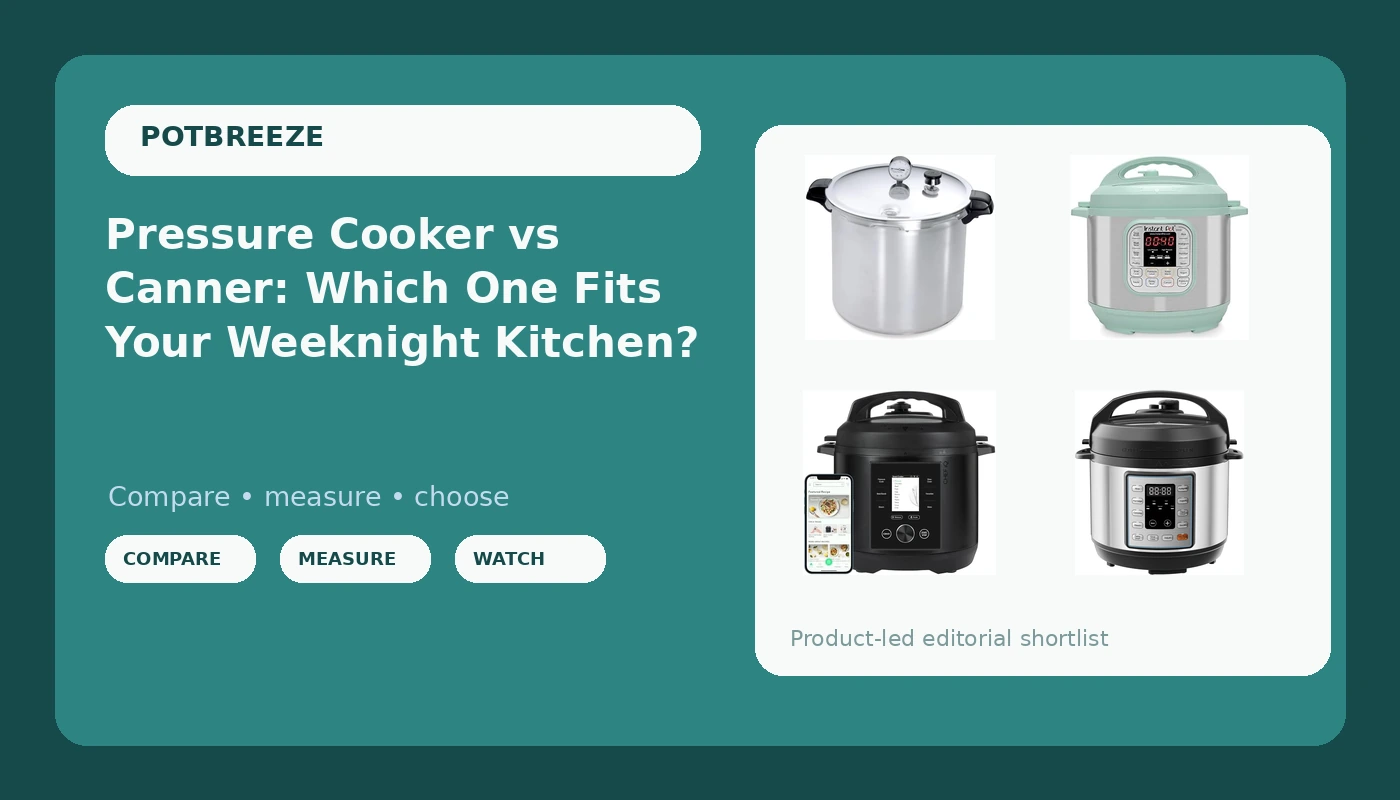
Pressure cookers and canners both cook food with steam under pressure, but they are not the same tool, and treating them as interchangeable is the fastest way to buy the wrong machine. An electric multicooker plugs into the wall, seals shut, and runs a preset program while you get on with something else. A stovetop pressure canner sits on a burner, holds a much larger load, and exists mainly so you can put up jars of tomatoes, beans, or stock in quantity. The four models in this guide split along exactly that line: two 6 quart electric multicookers, one compact 3 quart electric cooker, and one 23 quart stovetop canner.
The harder question is fit. How many people are you feeding, how much counter space can you give up permanently, what kind of cooktop do you have, and do you want the machine to guide you through a recipe or simply hold pressure while you work? Those four answers narrow the field faster than any feature list, and they are the reason two 6 quart cookers can still be the right answer for two very different kitchens.
Related: Instant Pot Duo vs CHEF iQ: which 6 quart cooker fits your kitchen? →
Quick answer
For everyday family cooking, a 6 quart electric multicooker covers the most jobs in a single pot, and the Instant Pot Duo 7-in-1 is the version most households land on because its seven functions line up with what a normal week actually requires. If you want the cooker to walk you through recipes and you like the idea of a built-in scale, the CHEF iQ is the guided option. If your goal is preserving food in jars, you need a stovetop pressure canner rather than an electric multicooker, and the Presto 01784 is built for that job with a 23 quart capacity. If you cook for one or two people, the OLIXIS 3 quart takes less counter space and makes less food. Capacity and power source decide more than the number of preset buttons on the front.
4 useful options
| Model | Best fit | What stands out |
|---|---|---|
| Instant Pot Duo 7-in-1 Electric Pressure Cooker, 6 Quart | Everyday family cooking | Seven functions in one 6 quart pot, including sauté and yogurt, with 14 one-touch programs |
| CHEF iQ Smart Pressure Cooker, 6 Quart | Guided cooking and recipe following | WiFi connection, a built-in scale, and 500+ guided recipes |
| Presto 01784 23-Quart Induction Compatible Pressure Canner | Stovetop canning and very large batches | 23 quart capacity with an induction compatible base |
| OLIXIS 10-In-1 Electric Pressure Cooker, 3 Quart | Small households and small batches | Compact 3 quart body, ceramic inner pot, and a slow cook function |
Everyday family cooking: Instant Pot Duo 7-in-1 Electric Pressure Cooker, 6 Quart
The trade-off with any 7-in-1 is depth. A single 6 quart insert does everything, which means it also does everything one batch at a time, and the sauté function on an electric cooker is a browning tool rather than a replacement for a heavy skillet over a hot flame. What you buy instead is counter space and cleanup. One insert, one lid, one pot to wash after the sear and the pressure cook happen back to back. For a household of four or five eating dinner at roughly the same time, that math usually wins.
Guided cooking with an app: CHEF iQ Smart Pressure Cooker, 6 Quart
The built-in scale is the feature that separates it from a generic multicooker, because weighing in the pot removes a step and a dirty bowl from baking-style recipes and from anything measured by grams. The caveat is dependency. Guided recipes live in an app, and an app means a phone nearby, an account, and a product that assumes its software keeps working. If you like following a structured recipe and you cook from a phone already, that is a feature. If you want a knob and a timer, it is a liability.
Stovetop canning and big batches: Presto 01784 23-Quart Induction Compatible Pressure Canner
The important distinction is that an electric multicooker is not a substitute for this. Manufacturer manuals for electric cookers generally advise against pressure canning in them, and home canning guidance from extension services is built around stovetop canners and tested processing times. So if preserving is the goal, this is the tool, and if weeknight dinner is the goal, this is a very large pot you have to watch. It also needs somewhere to live: 23 quarts does not tuck into a cabinet beside the sheet pans.
Small-batch cooking: OLIXIS 10-In-1 Electric Pressure Cooker, 3 Quart
The limitation is headroom. Pressure cookers need empty space above the food, and smaller inserts hit that ceiling sooner, which rules out a whole chicken or a big batch of stock. What a 3 quart does well is the daily work: rice, oatmeal, a pound of beans, a stew for two, steamed vegetables as a side. If you live alone or cook for two, buying a 6 quart means consistently cooking at half capacity, which is a real cost in cabinet space even when it is not a cost in performance.
Prices and availability may change. Product images, names, and retailer links must be matched by verified ASIN. Do not state a current price, rating, stock status, or measured result without current evidence.
Electric and stovetop pressure cookers: what actually changes
The power source changes almost everything about how you use the pot, even though the cooking physics are the same. An electric cooker has a heating element built into the base and a control board that manages the come-up, the cook time, and the release. That is why it can hold a keep-warm setting for an hour and why it can be left alone while you set the table. The cost is that you are cooking inside the manufacturer's parameters, and the sauté temperature is whatever the element and the insert can reach.
A stovetop cooker or canner has no element and no board. You bring it to pressure on a burner and manage the heat yourself for the whole cook, which is more attention and more control at the same time. It also scales up. Stovetop units are available in capacities an electric multicooker simply does not reach, which is why canning lives on the stovetop. Check your cooktop before you buy anything stovetop: a model with an induction compatible base is the version that works across gas, electric, and induction, and not every stovetop pot is built that way.
Two more differences show up in daily use. Electric cookers have a sealing ring, the silicone gasket in the lid that holds pressure, and that ring absorbs the smell of everything you cook. Before buying any model, confirm a replacement ring is sold for it, because a cooker with no available gasket is a disposable appliance. Electric cookers also give you two release methods: natural release, where pressure drops on its own, and quick release, where you vent it manually. Natural release is what makes shredded pork and beef chuck tender rather than tough, and it is the setting most people skip when they are hungry.
Five steps to a decision that holds up
Work through these in order and the choice usually makes itself.
- Write down what you cook most often. If the answer is soups, stews, beans, rice, and shredded meat, an electric multicooker covers nearly all of it. If the answer includes jars and a water bath, you need a canner.
- Match capacity to servings, not to ambition. A 3 quart suits one or two people, a 6 quart suits a family, and a 23 quart is a batch and canning tool rather than a dinner tool.
- Check your cooktop and your outlets. Stovetop models need a compatible burner, and induction compatibility has to be stated, not assumed.
- Decide between presets and manual control. Fourteen one-touch programs and 500+ guided recipes are genuinely useful if you want the machine to lead. If you prefer to set your own time and pressure, those buttons are decoration.
- Confirm the consumables before you commit. Replacement sealing rings, available lids, and a manual you can actually find matter more over five years than any single cooking mode.
What to check before you buy
- Read the fill lines in the manual and follow them. Most pressure cookers cap filling at about two-thirds, and closer to half for foods that foam or expand, such as beans and grains.
- Plan for natural release on tough cuts and quick release on vegetables and grains. The release method affects texture as much as the cook time does.
- Measure your cabinet clearance. A cooker with the lid locked and the vent open needs vertical room above it, and that is the measurement people forget.
- Verify that a replacement sealing ring is sold for the exact model. Rings pick up odors from strong dishes and are the part most likely to need replacing first.
- Preheat sauté mode before adding oil, and dry your meat first. A cold insert steams protein instead of browning it, which is the difference between one pot and two.
- Keep the vent and the float valve clear of debris, and never force a lid open while the pressure indicator is still up.
Which option should you choose?
Choose the Instant Pot Duo 7-in-1 Electric Pressure Cooker, 6 Quart when you feed a family on weeknights and want pressure cooking, slow cooking, rice, steaming, sauté, yogurt, and warming in one countertop appliance. Choose the CHEF iQ Smart Pressure Cooker, 6 Quart when you want the same family-size capacity but you would rather follow guided recipes and weigh ingredients in the pot with a built-in scale. Choose the Presto 01784 23-Quart Induction Compatible Pressure Canner when your goal is preserving food in jars or cooking in volumes no countertop cooker can hold, and you have a compatible burner. Choose the OLIXIS 10-In-1 Electric Pressure Cooker, 3 Quart when you cook for one or two, want a compact programmable pot with a ceramic insert and a slow cook function, and do not need to feed a crowd.
One caveat worth repeating: the details above come from the manufacturer descriptions for each model, not from independent lab testing, and this article does not claim measured results. Capacity, wattage, cooktop compatibility, and what ships in the box can change, so confirm them on the current product page before you buy.
The bottom line
Capacity and power source decide this purchase; the program count does not. A 6 quart electric multicooker is the practical center of a family kitchen, and the Duo covers the widest set of everyday jobs in one insert. The CHEF iQ is the same capacity aimed at cooks who want the machine to guide them, with a built-in scale doing real work. The Presto canner is the only one of the four built for preserving, and it is not a weeknight appliance. The OLIXIS is the right size when the household is small and counter space is tight. Pick the size you will actually fill, confirm the sealing ring is replaceable, and the rest of the decision is much smaller than it looks.