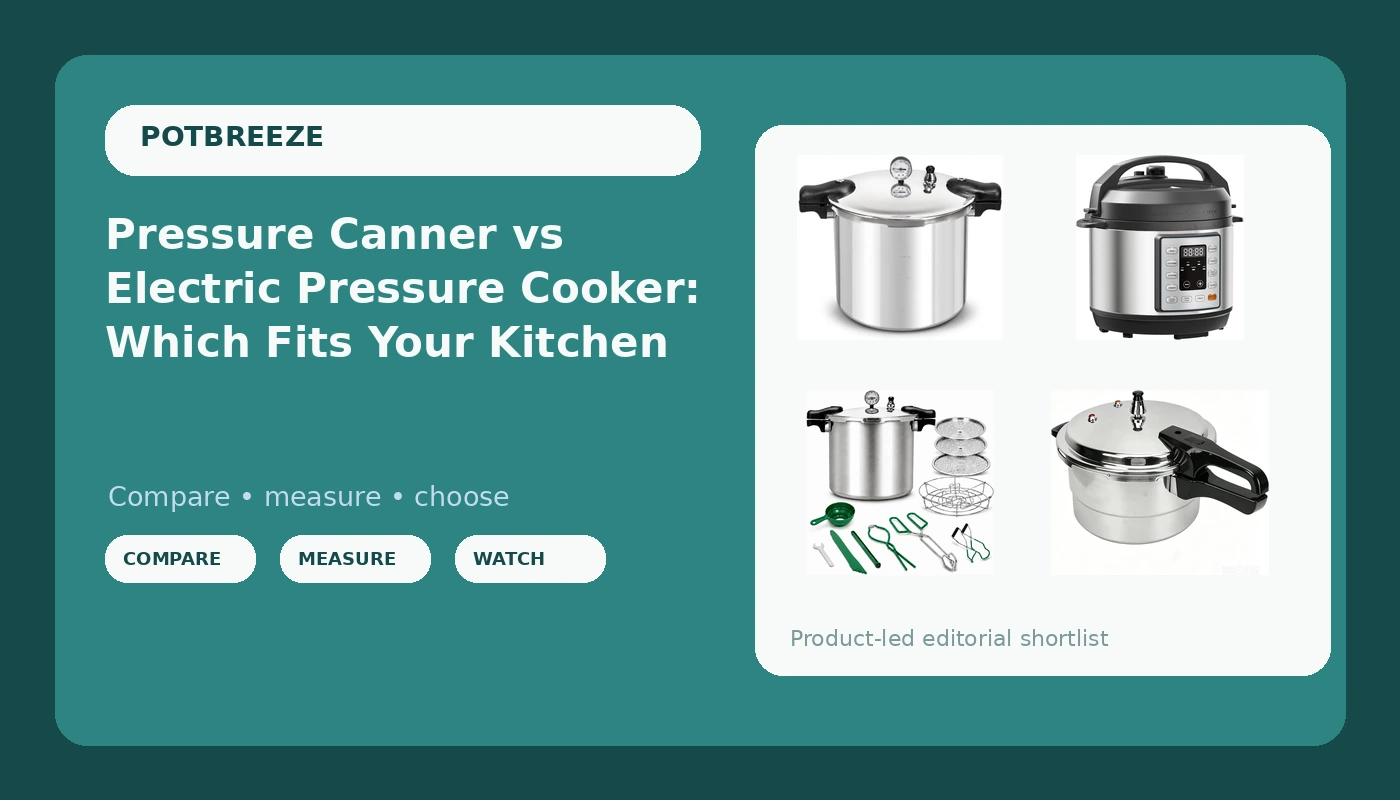
Choosing between a pressure canner and an electric pressure cooker is really a question about what you want to put in jars and what you want to put on plates. The two categories share a name and a lid, and almost nothing else. A pressure canner vs electric pressure cooker comparison comes down to three things: how much pressure the vessel holds, how much food fits inside it, and what heat source it needs. A stovetop canner is built to hold a steady, high pressure long enough to make low-acid food shelf stable. A countertop electric multi cooker is built to get dinner done faster than a covered pot on the stove. Buy the wrong one and you end up with a very large pot that never leaves the shelf, or a small cooker that cannot process a single quart of beans.
Related: How to Replace a Pressure Cooker Sealing Ring →
Quick answer
Match the machine to the job. For shelf-stable canning of low-acid foods, you want a stovetop canner sized to your batch and compatible with your stove, which is where the 24 quart canner and the 22 quart Barton unit live. For small-batch weeknight cooking, an electric countertop cooker such as the NEWBULIG 3 quart is the practical choice. For a compact stovetop pot that works on both gas and induction, the 4.2 quart aluminum cooker covers the middle ground. None of these is universally better than the others; they solve different problems.
4 useful options
| Model | Best fit | What stands out |
|---|---|---|
| 24 QT Pressure Canner for Induction and Gas, 14.5 PSI Precision Pressure Cooker for Canning, includes 2 Stainless Steel & 1 Aluminum Steamer Racks, 7-Piece Canning Supplies Starter Kit | Large-batch canning on induction or gas | Stated 14.5 PSI working pressure, three racks, and a 7-piece canning starter kit |
| Barton Pressure Canner Release Valve Aluminum Canning Pot Cooker Pot Stove Top with Pressure Gauge Instant Fast Cooking Pot Stewing Locking System (22 Quarts) Meat, Poultry & Vegetables | Stovetop canning and big-batch stewing | 22 quart aluminum body with a dial pressure gauge, release valve, and locking system |
| 4.2 Quart Pressure Cooker with Magnetic Bottom, Small Aluminum Alloy Pressure Pot with Release Valve & Multiple Protective Devices, Pressure Canner Compatible with Gas & Induction Cookers | Small stovetop batches on gas or induction | Magnetic bottom for induction, plus release valve and multiple protective devices |
| NEWBULIG 10-In-1 Electric Pressure Cooker, 3 Quart Multi Cooker for Rice, Stew and Steam, Small Programmable Stainless Steel Pot with Slow Cook Function and Ceramic Inner Pot | Countertop cooking for one or two | Programmable stainless steel body, ceramic inner pot, and a slow cook function |
Large-batch canning: 24 QT Pressure Canner for Induction and Gas, 14.5 PSI Precision Pressure Cooker for Canning, includes 2 Stainless Steel & 1 Aluminum Steamer Racks, 7-Piece Canning Supplies Starter Kit
The trade-off is bulk and storage. A 24 quart canner is a large piece of equipment, and it needs a burner wide enough to heat the base evenly. Induction compatibility matters here because not every aluminum canner works on an induction surface, and this one is listed for both induction and gas. If your canning is occasional and small, the capacity is more than you need, and the pot will spend most of the year on a shelf.
Stovetop canning and stewing: Barton Pressure Canner Release Valve Aluminum Canning Pot Cooker Pot Stove Top with Pressure Gauge Instant Fast Cooking Pot Stewing Locking System (22 Quarts) Meat, Poultry & Vegetables
A dial gauge is a maintenance item. Gauges can drift out of calibration over time and, depending on your local extension service, may need periodic testing. That is a real ownership cost that a weighted gauge or an electric appliance does not have in the same way. The upside is that you can read the pressure at any moment and adjust the burner, which many experienced canners prefer over listening for a jiggler.
Compact stovetop: 4.2 Quart Pressure Cooker with Magnetic Bottom, Small Aluminum Alloy Pressure Pot with Release Valve & Multiple Protective Devices, Pressure Canner Compatible with Gas & Induction Cookers
Be clear about what a pot this size is for. It is not a substitute for a full-size canner when you are putting up quarts of low-acid food, because batch capacity drives how many jars you can process at once, and small pots hold very few. Where it earns its place is as a compact stovetop cooker that stores in a cupboard, heats quickly, and works on the same induction surface as the rest of your pans.
Countertop convenience: NEWBULIG 10-In-1 Electric Pressure Cooker, 3 Quart Multi Cooker for Rice, Stew and Steam, Small Programmable Stainless Steel Pot with Slow Cook Function and Ceramic Inner Pot
The honest limitation is that countertop electric cookers are not canners, and the "10-in-1" label should not be read as ten genuinely distinct cooking methods. Many programs share the same pressure and heat behavior with different timers attached. What you actually gain is unattended cooking, a keep-warm stage, and a pot that does not tie up a burner.
Prices and availability may change. Product images, names, and retailer links are matched to verified listings. No current price, rating, stock status, or measured result is stated here without current evidence.
Why a canner and a multi cooker are not interchangeable
The difference is not marketing, it is what the vessel is designed to survive. Pressure canning low-acid foods such as vegetables, meats, and stocks requires holding a specified pressure for a specified time so that the interior of the jar reaches a temperature that destroys the organisms that cause spoilage and, in the worst cases, serious illness. That is why canning guidance is written around pressure and time, and why the pot has to hold pressure steadily rather than cycle up and down.
Countertop electric cookers are designed around cooking food that will be eaten soon. They pressurize, cook, and release, and their pressure ceilings are generally lower than a purpose-built stovetop canner. Some of them are explicitly not approved for pressure canning, and even when a manufacturer permits it, the batch size is usually tiny. If your goal is jars on a shelf, buy a canner. If your goal is dinner on a Tuesday, buy the countertop cooker.
Pressure ratings, gauges, and what to verify before you buy
Two numbers matter. The first is working pressure: the 24 quart canner here is listed at 14.5 PSI, which is the kind of figure a canner needs to reach. The second is your altitude, because the pressure required to reach a given internal temperature rises as you go higher above sea level. Published canning guidance ties pressure to altitude, so a pot that works fine at sea level may need a higher setting in the mountains.
Gauge type is the other decision. A dial gauge gives you a reading at a glance but is a component that can lose accuracy and may need testing. A weighted gauge regulates by rocking or jiggling and is less dependent on calibration. Both approaches appear in canning literature, and the right answer depends on how much attention you want to pay during a long process.
- Decide what you are processing: jars for shelf storage, or food for this week's dinners.
- Measure your largest realistic batch in quarts, then choose a canner that holds that batch with room for racks.
- Check your cooktop: induction and gas are listed on two of these units, and an induction surface needs a magnetic base or a compatible disc.
- Confirm the pressure figure and the gauge type against the canning guidance for your altitude.
- Confirm that the parts that wear, especially gaskets and sealing rings, can be replaced separately before you commit.
Practical guidance for either path
- Read the manufacturer's canning instructions and follow them over any general article, including this one.
- Never can low-acid food in a countertop electric cooker unless the manufacturer explicitly says it is approved for that use.
- Vent the canner according to instructions before bringing it to pressure, since trapped air changes the internal temperature.
- Keep the sealing ring clean and odor-free, and replace it when it hardens or stops sealing.
- Check the pressure gauge periodically, and use a tested gauge when your local extension service offers that.
- Match the pot to the burner: a wide canner on a small burner heats unevenly and takes longer to come to pressure.
Which option should you choose?
Choose the 24 QT Pressure Canner for Induction and Gas, 14.5 PSI Precision Pressure Cooker for Canning, includes 2 Stainless Steel & 1 Aluminum Steamer Racks, 7-Piece Canning Supplies Starter Kit when you process large batches of jars and cook on induction or gas. Choose the Barton Pressure Canner Release Valve Aluminum Canning Pot Cooker Pot Stove Top with Pressure Gauge Instant Fast Cooking Pot Stewing Locking System (22 Quarts) Meat, Poultry & Vegetables when you want a dial gauge you can watch and a classic 22 quart aluminum canner that doubles as a stew pot. Choose the 4.2 Quart Pressure Cooker with Magnetic Bottom, Small Aluminum Alloy Pressure Pot with Release Valve & Multiple Protective Devices, Pressure Canner Compatible with Gas & Induction Cookers when you want a small stovetop pot for sides and beans on an induction or gas burner. Choose the NEWBULIG 10-In-1 Electric Pressure Cooker, 3 Quart Multi Cooker for Rice, Stew and Steam, Small Programmable Stainless Steel Pot with Slow Cook Function and Ceramic Inner Pot when you cook for one or two and want programmable, unattended cooking on the counter.
One caveat applies to all four: this article describes what each listing states and how the categories differ. It does not report a measured pressure test, a timed cook, or a canning result, and it states no current price or rating. Treat the manufacturer's documentation and current USDA-style canning guidance as the authority for anything you intend to store in a jar.
The bottom line
The pressure canner vs electric pressure cooker question has a short answer once you name the job. Shelf-stable canning needs a stovetop canner that reaches and holds canning pressure, sized to your batch and matched to your cooktop, which is the case for the 24 quart unit and the 22 quart Barton. Weeknight cooking for a small household needs an electric countertop cooker, which is the case for the NEWBULIG 3 quart. The 4.2 quart stovetop pot sits between them for anyone who wants a compact pressure vessel on gas or induction. Pick the category first, then the size, then verify the replaceable parts.