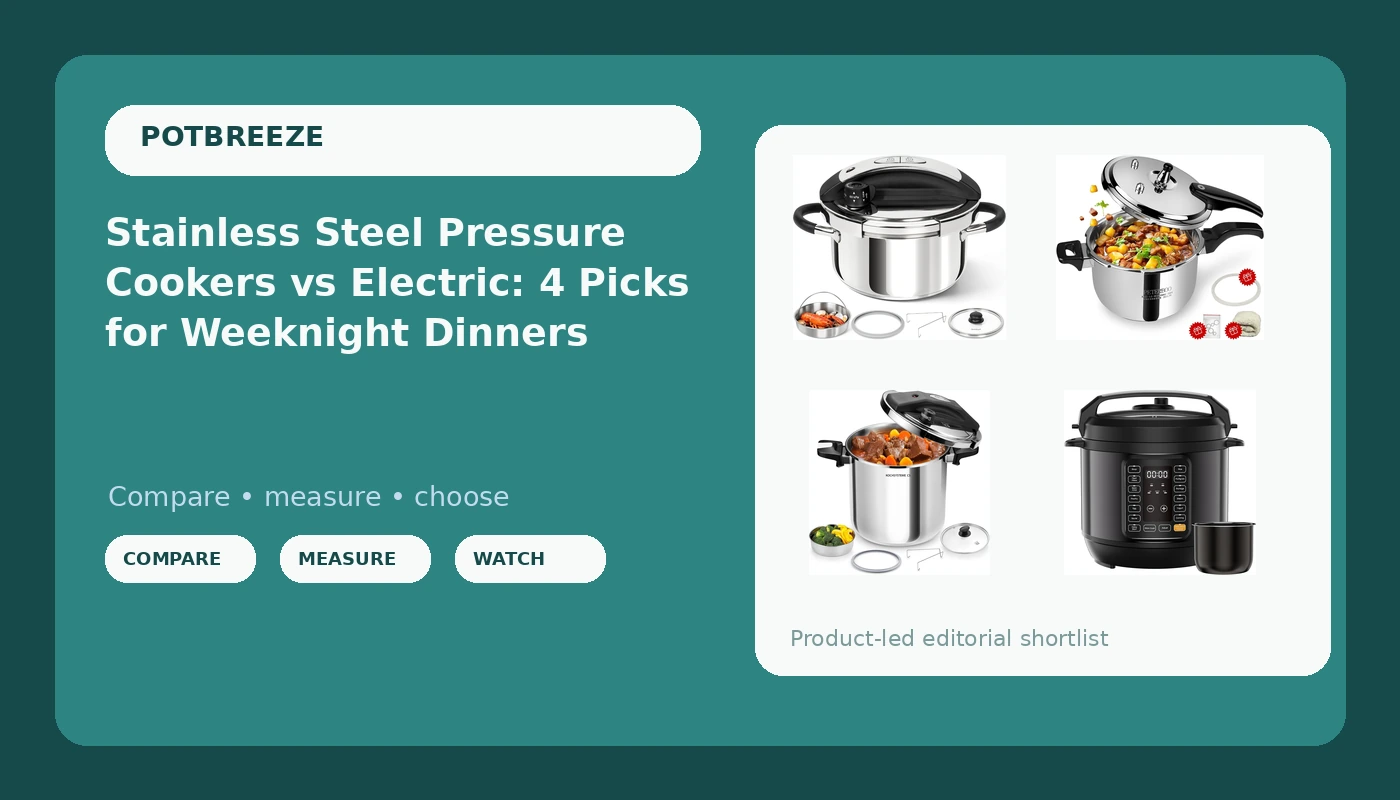
I cook dinner for five people, five nights a week, and most nights I have about 40 minutes between the last work call and the first complaint about being hungry. That is why two kinds of cooker live on my shelf: a stainless steel pressure cooker for the nights I want a real sear before the lid goes on, and an electric multi cooker for the nights I want to walk away and come back to dinner. This comparison puts three stainless steel pressure cookers against one 8-quart electric, and it runs on the four questions I ask before any cooker earns counter space. Does the browning step actually work? Does it come to pressure and hold it? Can I buy a replacement sealing ring? And would it survive 30 weeknight dinners in a house with five opinions?
The short answer: the DUMOS Electric Pressure Cooker 16-in-1 in 8QT is the one I would hand to most families, because it feeds five, it holds dinner warm until the last person is home, and it does the work while you do something else. If you sear the way a line cook does, the KOCH SYSTEME CS 8.5 Quart stainless cooker is the better pot and the better sear, and it is worth learning the rhythm of a stovetop cooker to get it.
The four cookers at a glance
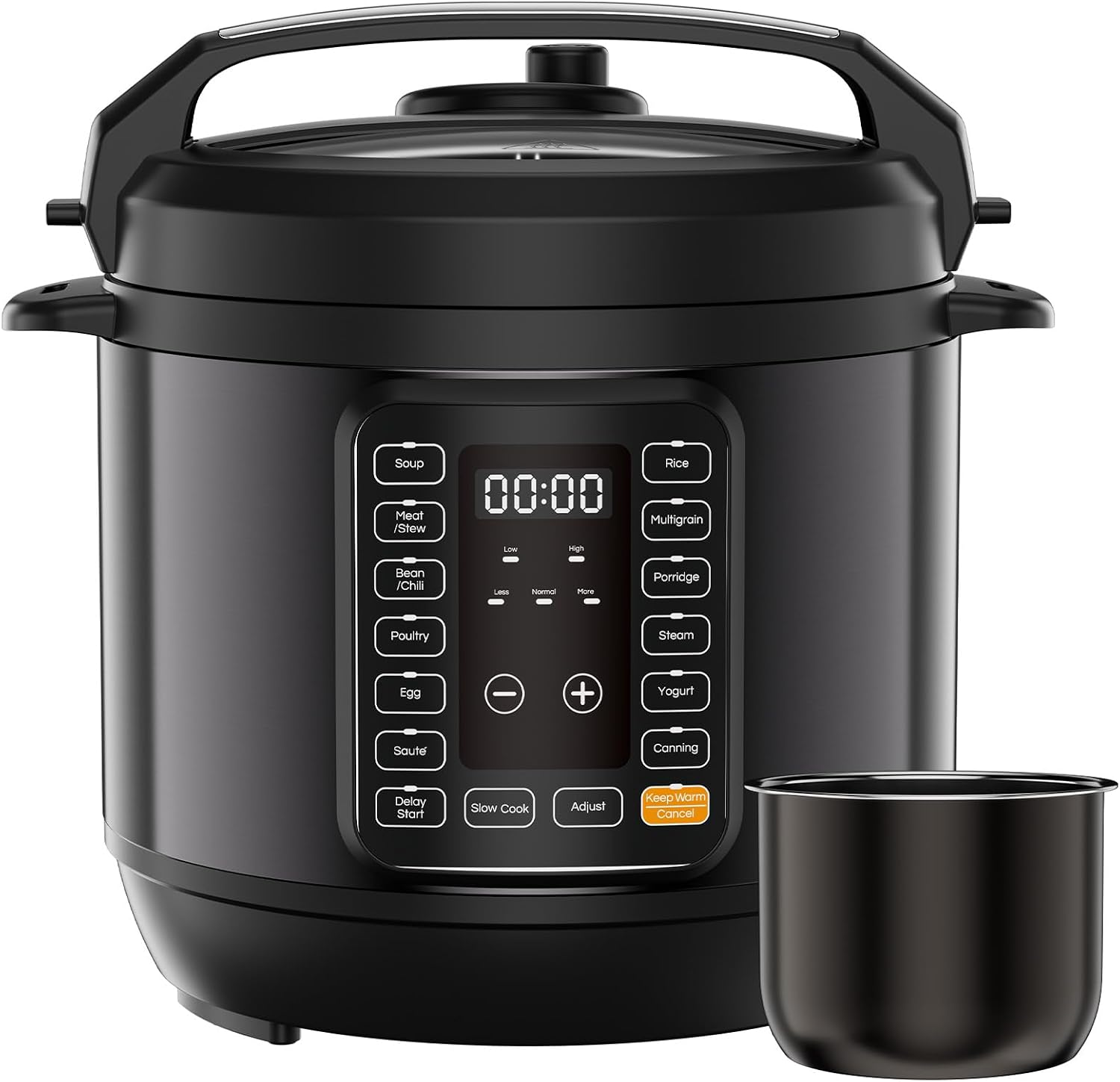
DUMOS Electric Pressure Cooker 16-in-1, 8QT
12 one-touch presets, delay start and keep warm, ceramic inner pot big enough for a family of five
Electric browning is not stovetop browning, and 16 programs is more buttons than a weeknight needs
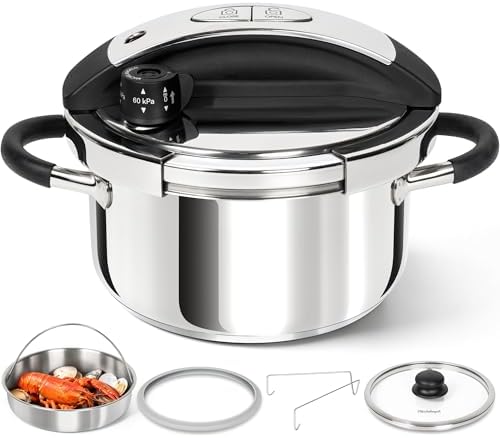
MICHELANGELO 3.2QT Stainless Steel Pressure Cooker
One-touch locking lid is genuinely simple, and 3.2QT is right for sides, grains and small batches
Side-dish capacity, not dinner capacity, and it keeps you standing at the stove
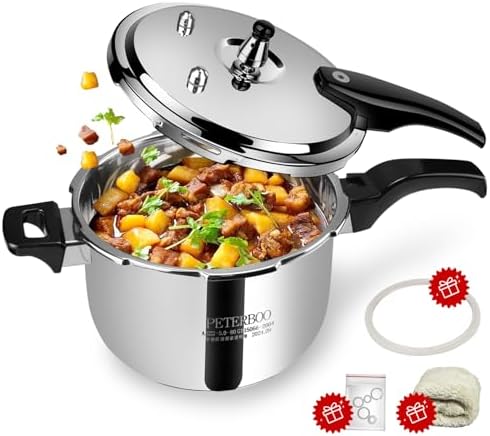
Premium Stainless Steel Small Pressure Cooker 3 quart
8 listed safety features, quick cooking, and the easiest of the four to store
3 quarts is tight for a family, and there is nothing programmable about it
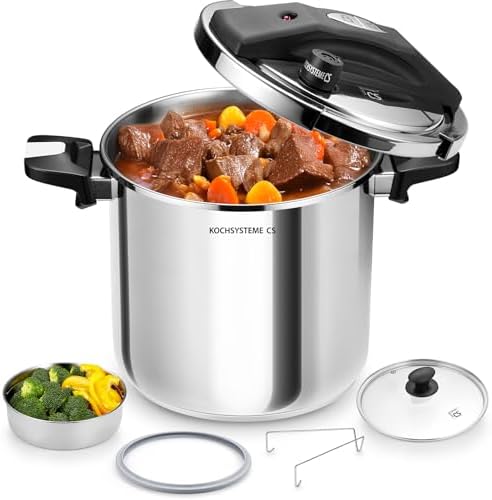
KOCH SYSTEME CS Stainless Steel Pressure Cooker 8.5 Quart
8.5QT with 3 PSI settings, one-hand locking, glass lid and steamer included, induction ready
Biggest footprint of the four, and it demands your attention while it runs
Prices and availability were captured from Amazon Creators API and may change.
How I judge a pressure cooker
I have owned eleven pressure cookers in fifteen years, starting with a rattling stovetop model my grandma handed down and ending with a shelf that currently holds both stovetop and electric cookers. In that time I have learned that the spec sheet is not the review. The things that actually matter are boring and repeatable.
First, sauté. If the browning step is weak, you will dirty a second pan, and a pressure cooker that sends you to the skillet is a stew maker with extra steps. Second, time to pressure and stability once it gets there. A cooker that hisses and wanders makes you nervous, and nervous cooks open the lid early. Third, the sealing ring. That silicone gasket is the part that holds pressure and absorbs every curry you have ever made. If you cannot buy a replacement, the cooker is disposable, no matter what the box promises. Fourth, keep warm, which is where weeknight dinners are actually won. Food that is ready at 6:10 and still good at 7:00 beats food that was perfect for four minutes.
Everything below gets judged on those four things, plus one more: whether the cooker would still be pleasant on the thirtieth dinner.
The electric pick: DUMOS Electric 16-in-1, 8QT
The DUMOS is the only electric cooker here, and it is the one that fits how a family actually eats. Eight quarts is real capacity: a pot of chili for five with leftovers for Tuesday, a whole chicken, a batch of yogurt without a second appliance. The 12 one-touch presets cover the things you make on repeat, soup and steam and yogurt among them, and the ceramic inner pot is the detail I care about most, because it is the difference between a pot that releases a braise and one you scrub. Delay start means you can load it in the morning and walk out. Keep warm means dinner is still dinner when practice runs late. There is a recipe guide in the box, which matters more than it sounds if you have never cooked under pressure.
What it loses is electric browning. Sauté on any electric cooker is a compromise, and no preset list changes that. If you want fond on the bottom of the pot, this is not the tool. If you want dinner handled while you are doing three other things, it is.
The big stovetop: KOCH SYSTEME CS 8.5 Quart
This is the cooker for the person who wants a pot first and a gadget second. 8.5 quarts, stainless steel, one-hand locking, and three PSI settings, which is the feature that separates it from most stovetop cookers at this size. Three pressure levels means you can cook delicate things gently and root vegetables hard, instead of treating every recipe the same way. It is rated for induction, which matters if your kitchen has moved that direction. And it ships with a glass lid and a steamer insert, which quietly turns one pot into three: pressure cooker, stock pot, steamer.
The trade-offs are the classic stovetop trade-offs. It takes up the most space of the four. It needs your attention: you bring it up, you turn it down, you time it, you release it. And it will rattle, which scares beginners and is completely normal. If you already stand at the stove for 40 minutes, that is not a cost. If you do not, it is.
The mid-size stainless: MICHELANGELO 3.2QT
3.2 quarts with a one-touch locking lid. This is the size I reach for when the big cooker is overkill: rice for five as a side, a pound of dried beans, stock from a roast chicken carcass, steel-cut oats on a Sunday. The one-touch lid is the selling point, because the fiddliest part of any stovetop cooker is seating and locking the lid while the pot is hot, and a lid that closes in one motion removes most of that frustration. Stainless steel means no coating to worry about and nothing in the pot body holding on to last night's onions.
Where it loses: 3.2 quarts is a side-dish capacity, not a dinner capacity. For a family of five this is a second cooker, not a first one. And like every stovetop cooker, it keeps you in the kitchen. Check your cooktop compatibility before you buy, because not every stainless cooker is rated for induction.
The small budget stovetop: Premium Stainless Steel Small Pressure Cooker 3 quart
This one is the entry point, and it is honest about what it is. 3 quarts, stainless steel, eight listed safety features, and a design built around quick cooking rather than programmability. If you are pressure-curious and you do not want to spend electric-cooker money to find out whether you like this way of cooking, this is the least expensive way to learn. It is also the easiest of the four to store, which matters in a kitchen that already has too much in it.
The limits are real. Three quarts feeds two comfortably, three if nobody is very hungry. There is no delay start, no keep warm, no preset doing the thinking for you. And the learning curve on a stovetop cooker is genuine: you have to learn the sound of full pressure and the feel of a natural release. Buy it as a learner pot or a small-batch pot, not as the family workhorse.
Stovetop or electric: the trade-off nobody explains
Here is the part most buying guides skip. These two categories are not competing for the same job.
An electric cooker like the DUMOS wins on attention. You load it, you set it, you leave. It holds food at serving temperature for as long as your schedule demands, which is the single most useful feature in a house with a teenager. It loses on sear and on ceiling. You cannot brown a roast the way a restaurant does, and once the pot is sealed, you are cooking the recipe the machine understands.
A stovetop stainless cooker wins on heat and on honesty. You control the flame, you control the pressure level, and the pot does exactly what you tell it. The KOCH SYSTEME CS with its three pressure settings gives you more control than any electric unit at this price. What you pay for that control is presence. Somebody has to stand there.
My rule, after fifteen years: if your weeknights are scheduled to the minute, buy the electric. If your weeknights are spent in the kitchen anyway, buy the stovetop. If you are honestly not sure, buy the electric first and add a 3-quart stainless cooker later, because the two together cover almost everything.
Sealing rings, vents, and the maintenance nobody mentions
The sealing ring is the part that decides whether a pressure cooker is a ten-year purchase or a two-year mistake. It is silicone, it sits in the lid, and it is the reason your cooker holds pressure at all. It also absorbs odor. If you make chili on Sunday and applesauce on Wednesday, you will taste Sunday in Wednesday's applesauce. That is not a defect, it is chemistry, and the fix is a spare ring.
So before you buy any of these four, find the replacement ring for that exact model. If it does not exist as a separate purchase, walk away. A cooker with a sealed-in gasket is disposable, and you will be replacing the whole unit instead of a five-dollar part.
Two more maintenance habits. Wash the ring by hand and let it air dry rather than baking it in a dishwasher cycle, and check the vent and the float valve for starch residue after every bean or grain cook, because that is what causes the sputtering spray that hits your ceiling. None of this is difficult. It is just the difference between a cooker you like in year three and a cooker you resent in year one.
Which one should you buy
- Buy the DUMOS Electric 16-in-1, 8QT if you cook for four or more, you want dinner ready when you are, and you would rather press one button than watch a gauge. It is the best first pressure cooker of the four for a busy household.
- Buy the KOCH SYSTEME CS 8.5 Quart if you sear, you brown, you make stock from scratch, and you want one stainless pot that also steams. Best cooker here for someone who already loves the stove.
- Buy the MICHELANGELO 3.2QT if you want a second stainless cooker for sides, grains, and small batches, and you want the simplest lid in the group.
- Buy the Premium Stainless Steel Small Pressure Cooker 3 quart if you are learning, you cook for one or two, or you want a small stainless cooker without spending much to find out whether stovetop pressure cooking is for you.
Three questions I get asked
Can I use a stainless steel pressure cooker on an induction cooktop? Sometimes. The KOCH SYSTEME CS 8.5 Quart is listed as induction compatible. For the other stainless models, verify it on the product listing before you order, because a cooker that will not heat on your range is an expensive paperweight.
Do I need both a 3-quart and an 8-quart? If you cook for five, yes, eventually. The big cooker handles dinner and the small one handles rice, beans, and stock at the same time. Running two cookers on a Sunday is how you get a week of lunches without a second cooking session.
How often should I replace the sealing ring? Once a year is the honest answer, and sooner if you cook a lot of curry, chili, or anything with heavy spice. If the ring looks stretched, cloudy, or no longer seals without force, replace it before you blame the cooker.
Pick the one that matches your weeknights, not the one with the longest feature list. The cooker you actually use on a Tuesday is the only one that was worth buying, and for most families reading this, that is the electric 8-quart, with a small stainless pot waiting on the shelf for the nights you have ten extra minutes and want a better sear.