Pressure cookers are not one appliance. They are a family of appliances that happen to share a lid and the same physics trick, and the differences between them decide whether dinner takes twenty minutes or two hours, whether you wash one pot or three, and whether the thing earns permanent counter space or gets buried in a cabinet. That is the problem this explainer solves. If you are shopping for stainless steel pressure cookers and every listing starts to look identical, the useful question is not which one is best. It is which size, which heat source, and which level of automation matches the way you actually cook on a Tuesday night.
Related: Stovetop vs Electric Pressure Cookers: Which One Fits Your Kitchen? →
Quick answer
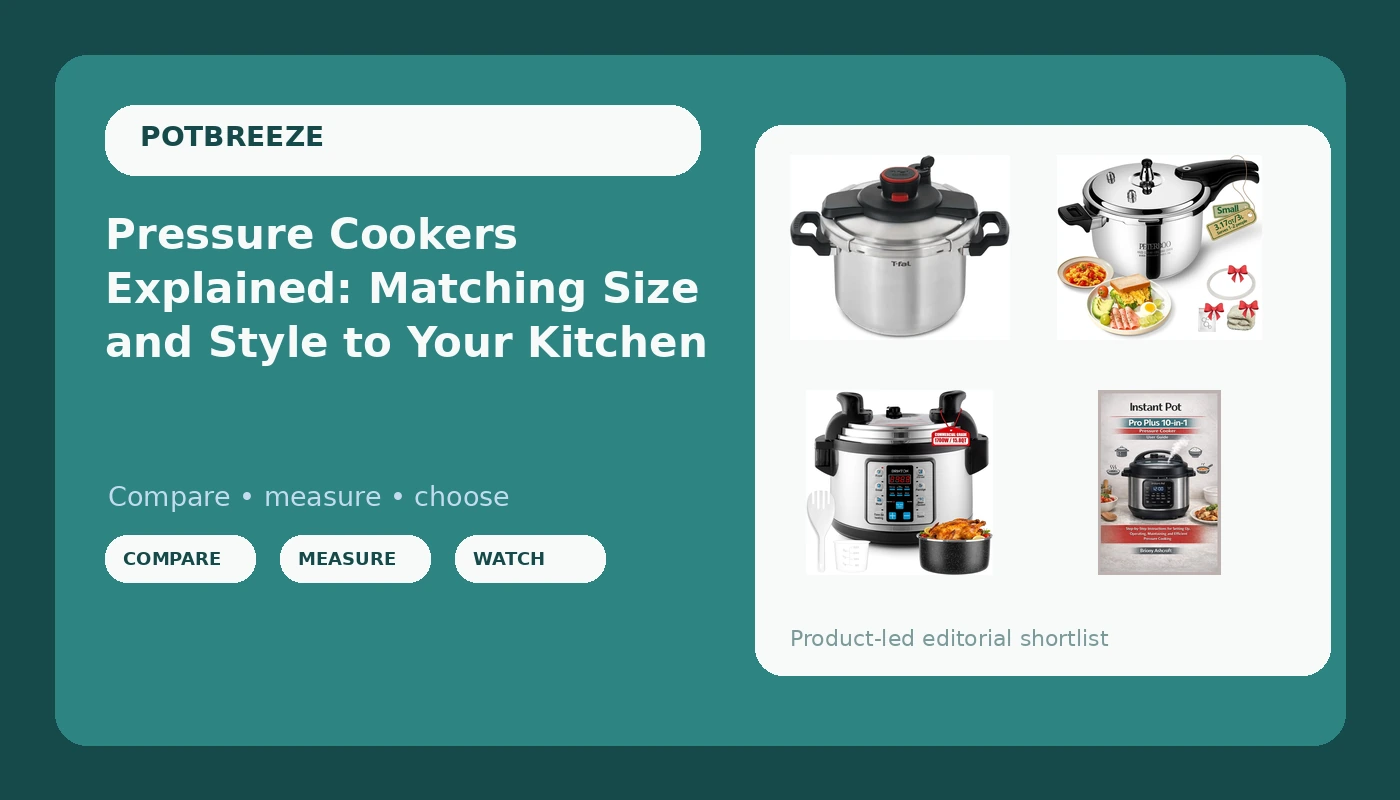
Match the cooker to your batch size and heat source before you look at features. A stovetop cooker gives you higher searing heat and works on induction, gas, and electric coils, but you control the pressure and the timing. An electric cooker trades some searing power for preset programs, a timer, and keep-warm. The four items below cover a 6.3 quart stovetop pot, a compact 3 quart stovetop pot, a large 15 liter electric unit built for big batches, and a written guide for the Instant Pot Pro Plus. They are not interchangeable, and none of them is right for every kitchen.
Four useful options
| Model | Best fit | What stands out |
|---|---|---|
| T-fal Clipso Stainless Steel Pressure Cooker, 6.3 Quart | Households of four to six cooking on any stovetop | 6.3 quart stainless body, easy-open lid, secure locking system, adjustable pressure valve, induction compatible |
| Small Stainless Steel Pressure Cooker 3 Quart Mini Size | Singles, couples, side dishes, grains, camping | Compact 3 quart stainless design built for small batches |
| Commercial Pressure Cooker, 15 Liter / 15.8 Quart | Large gatherings, canning volume, 25 to 35 people | 1700W electric stainless pot, 5 preset functions, 24 hour timer |
| Instant Pot Pro Plus 10-in-1 Pressure Cooker User Guide | New owners of the Instant Pot Pro Plus | Step-by-step setup, operation, maintenance, and pressure cooking instructions |
The everyday stovetop: T-fal Clipso Stainless Steel Pressure Cooker, 6.3 Quart
The trade-off with any stovetop cooker is attention. You bring it up to pressure on the burner, then you turn the heat down and manage it yourself. In exchange, you get a pan that can take real burner heat for browning before the lid goes on, and there is no cord, no control panel, and no electronics to fail. The 6.3 quart size is the sweet spot for a family that wants leftovers without hauling out a second pot. It is also the format that asks the most of a beginner, because you are the timer and the thermostat.
The small-batch pick: Small Stainless Steel Pressure Cooker 3 Quart Mini Size
Small cookers are underrated and also easy to misbuy. The upside is speed: less volume means less liquid to heat and less time to reach pressure, which is exactly what you want for a cup of rice, a batch of beans for two, or a quick vegetable side while something else owns the oven. The limitation is that a small pot fills up fast. You cannot pile a family-sized chili into a compact body and expect it to cook evenly, and most manufacturers want headroom for steam. Buy this size because your portions are genuinely small, not because you hope to save cabinet space and still feed five.
The large-batch electric: Commercial Pressure Cooker, 15 Liter / 15.8 Quart
This is the unit you consider when the normal sizes stop being relevant. Fifteen liters is not a family pot; it is a pot for a party, a church supper, a batch of stock you intend to freeze, or a serious canning session. The electric format with presets and a 24 hour timer means you are not standing over a burner watching a gauge, which matters when a big batch needs a long, steady cook. The honest trade-off is footprint and inertia. A cooker this large takes up serious storage and counter room, and it does not scale down gracefully, so it is a poor choice for someone who mostly makes two servings of oatmeal.
The companion guide: Instant Pot Pro Plus 10-in-1 Pressure Cooker User Guide
A manual is not a glamorous purchase, and that is the point. Electric multi-cookers bury a lot of behavior behind a panel of buttons, and the included documentation is often thin. If you already own the Pro Plus, a written guide is a low-cost way to get past the guesswork on setup, maintenance, and technique without watching a twenty minute video. It is also the only item here that is not a cooking vessel, so treat it as an accessory decision rather than a cooker decision.
Prices and availability may change. Product images, names, and retailer links must be matched by verified ASIN. Do not state a current price, rating, stock status, or measured result without current evidence.
How pressure cooking actually works
Pressure cooking works because trapped steam raises the boiling point of water. Seal a pot, let liquid turn to steam that cannot escape, and the internal temperature climbs above the normal boiling point. Food that would simmer for hours at ambient pressure cooks faster at the higher temperature, and collagen in tough cuts breaks down in a fraction of the time.
Two terms decide your results. The first is coming to pressure, the period where the pot heats, the valve seals, and internal pressure builds. The second is release. A natural release lets pressure fall on its own as the pot cools, which keeps liquid and heat inside and is generally the safer path for large volumes of liquid, foamy foods, and tough cuts. A quick release vents steam deliberately, which stops the cooking immediately and is useful for vegetables and grains, but it can spray if the pot is overfilled. Most recipes specify which one to use, and ignoring that instruction is the most common reason a dish comes out wrong.
Sizing a cooker to your household, in five steps
- Count the servings you actually cook, not the ones you might cook. A 3 quart pot suits one or two people; a 6.3 quart pot handles a family with leftovers; a 15.8 quart unit is for large groups and bulk batches.
- Decide your heat source. Stovetop cookers work on gas, electric, and induction and offer direct burner control. Electric units plug in, hold their own pressure, and add timers and presets.
- Check whether the cooker can brown. If the pot cannot sear, you will either accept pale food or dirty a second pan, which changes your cleanup math.
- Confirm the sealing ring is replaceable. A gasket that cannot be bought separately eventually turns a working cooker into a disposable one.
- Read the release instructions before you buy, not after. Some recipes and some volumes require a natural release, and a cooker that makes that awkward will frustrate you.
Practical guidance before you buy
- Measure your cabinet first. A large electric unit needs vertical clearance and a nearby outlet, and a big stovetop pot needs a burner that matches its base.
- Check the minimum liquid requirement in the manual. Every pressure cooker needs enough liquid to generate steam, and small pots hit that floor quickly.
- Plan for the gasket. Sealing rings absorb odors from strong dishes, so a spare ring or a second ring kept for savory versus sweet cooking is a real convenience.
- Treat the timer as the feature that earns its place. A 24 hour timer or a keep-warm function is what makes a cooker useful on a weeknight when dinner time is not precise.
- Keep the vent clear and never overfill past the marked line. Most pressure cooker incidents trace back to filling above the maximum mark or blocking the valve.
Which option should you choose?
Choose the T-fal Clipso Stainless Steel Pressure Cooker, 6.3 Quart when you cook for a family on a standard stovetop, want induction compatibility, and prefer direct burner control with a stainless body. Choose the Small Stainless Steel Pressure Cooker 3 Quart Mini Size when your portions are small, you mostly make grains and side dishes, or you want something compact enough to travel. Choose the Commercial Pressure Cooker, 15 Liter / 15.8 Quart when you regularly cook for crowds of 25 or more and want presets and a 24 hour timer doing the watching. Choose the Instant Pot Pro Plus 10-in-1 Pressure Cooker User Guide when you already own that appliance and want structured setup, maintenance, and technique instructions in writing.
The caveat is that these four items are not competitors in a single category. Two are stovetop pots, one is a large electric appliance, and one is a book. Capacity figures and wattage come from the product listings, and your own stove, outlet, and storage space will shape the decision as much as any specification.
The bottom line
The right pressure cooker is the one whose size matches your real portions and whose heat source matches your real kitchen. Start with servings and stovetop versus electric, then check the details that are easy to overlook: whether the pot can sear, whether the sealing ring can be replaced, and what the release instructions demand. A 6.3 quart stovetop pot, a compact 3 quart pot, a 15.8 quart electric unit, and a written guide for the Pro Plus solve four different problems. Pick the problem that is actually yours, and check the current Amazon price on the listing before you commit.