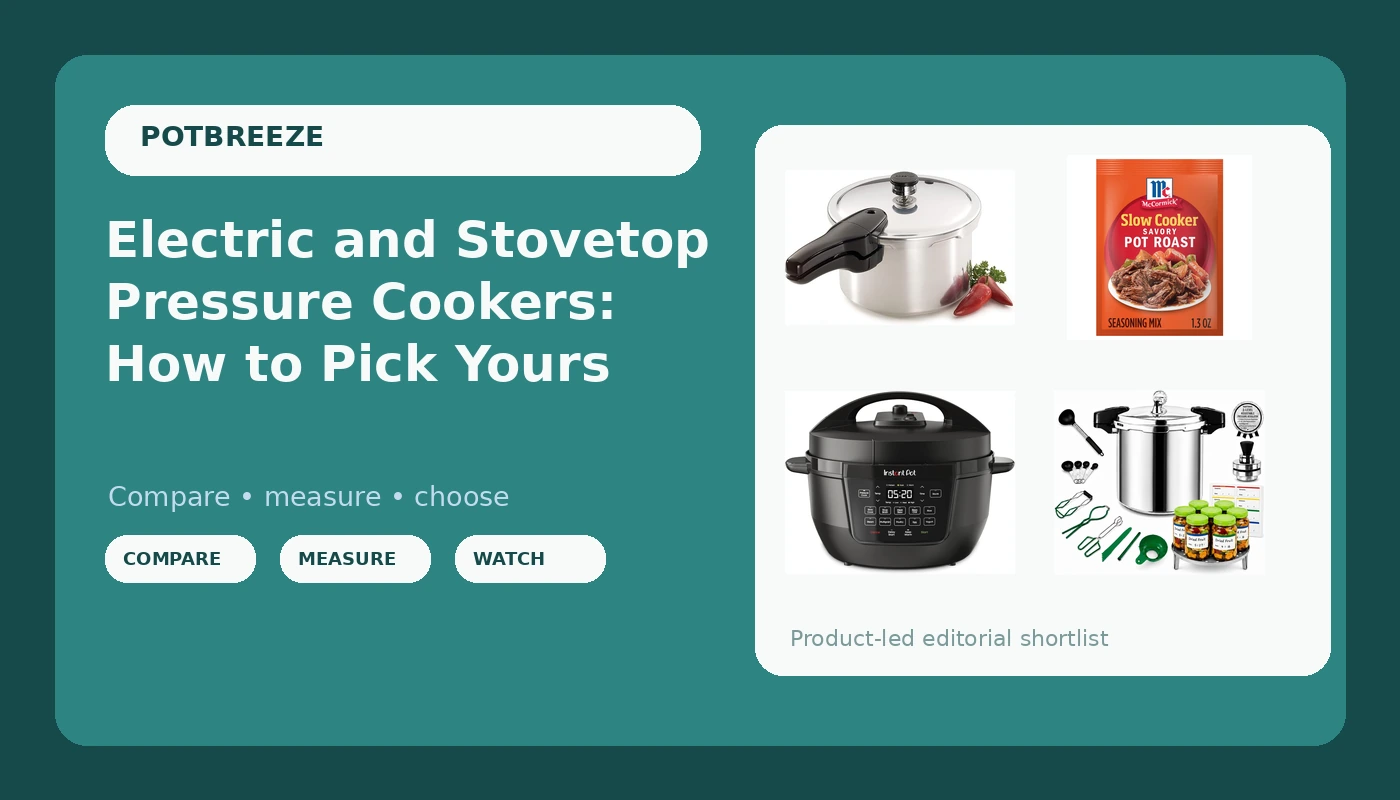
Electric and stovetop pressure cookers both cook food fast under sealed steam, but they ask very different things of the person standing at the counter. One plugs in, counts down, and holds dinner warm until you get to it. The other sits on a burner, builds pressure through direct heat, and keeps you in the loop for the whole cook. Most shoppers get stuck because they compare button counts instead of comparing the three things that actually change a weeknight: how the cooker reaches and holds pressure, whether it can sear before the lid goes on, and how easy it is to keep running for years. This explainer covers four options that handle those jobs in different ways, plus the checks worth running before you spend anything.
Related: Instant Pot vs Stovetop: Which Cooker Fits a Weeknight →
Quick answer
Choose an electric multicooker if you want programmed pressure cooking, a timer, and a keep-warm function that finishes dinner without you. Choose a stovetop cooker if you want direct burner control, a smaller footprint, and no electronics to fail. Choose a pressure canner if your goal is processing jars of low-acid food, which a countertop multicooker is not built to do. A seasoning packet is a flavor shortcut, not a cooker. Capacity and pressure regulation matter more than the number of preset buttons on the front panel.
4 useful options
| Model | Best fit | What stands out |
|---|---|---|
| Instant Pot Rio Wide 7.5 Qt 7-in-1 Electric Pressure Cooker, WhisperQuiet | Family-size weeknight electric cooking | 7.5 quart capacity, 7-in-1 cooking programs, WhisperQuiet steam release |
| 24QT Pressure Canner, 11-Piece Kit, Gas & Induction, 5/10/15 PSI Regulator | Canning jars and very large batches | 24 quart capacity, 11-piece kit, selectable 5/10/15 PSI regulator, gas and induction compatible |
| Presto 01241 4-Quart Aluminum Pressure Cooker | Small stovetop batches with hands-on control | 4 quart aluminum body, stovetop operation, no electronics |
| McCormick, Slow Cooker Savory Pot Roast Seasoning Mix, 1.3 Oz (Pack of 1) | A pot roast shortcut for a cooker you already own | Single 1.3 ounce packet of premeasured seasoning |
Electric all-rounder: Instant Pot Rio Wide 7.5 Qt 7-in-1 Electric Pressure Cooker, WhisperQuiet
The trade-off with any electric cooker is that you are renting control rather than holding it. The machine decides how the element cycles, how fast it comes to pressure, and when it releases. That is a feature on a Tuesday night, and a limitation when you want to push a sear or run a fast, hard boil. Two checks matter more than the function list. First, confirm that replacement sealing rings and a spare inner pot are sold separately, because a gasket you cannot replace turns the whole appliance into a disposable. Second, look at the width of the insert if you plan to brown meat before pressure cooking, since surface area is what makes a sear work.
Canning and bulk batches: 24QT Pressure Canner, 11-Piece Kit, Gas & Induction, 5/10/15 PSI Regulator
The reason a canner is not interchangeable with an electric cooker comes down to pressure accuracy and volume. Low-acid foods, which includes most vegetables, meats, and stocks, need a sustained, known pressure for a tested amount of time, and that pressure requirement changes with your altitude. The selectable regulator is what lets you match the setting to your elevation instead of guessing. Follow published, tested canning procedures rather than improvising times, and treat the gauge and regulator as equipment that deserves an occasional check. A 24 quart body is also genuinely large, so measure your burner and your cabinet before committing to the footprint.
Stovetop classic: Presto 01241 4-Quart Aluminum Pressure Cooker
This is the option that teaches technique fastest, because it will not hide anything from you. You learn to listen for the weight, to dial the burner down once pressure is reached, and to respect a natural release instead of yanking the valve. The learning curve is real, and the noise of a stovetop cooker in a quiet kitchen surprises people the first time. Two practical cautions: 4 quarts fills up quickly once you leave headroom for expansion, and aluminum bodies are not automatically induction friendly, so check your cooktop type before buying. The upside is a pot with no circuit board, which means the only parts that wear out are the ones you can usually replace.
Flavor shortcut: McCormick, Slow Cooker Savory Pot Roast Seasoning Mix, 1.3 Oz (Pack of 1)
A seasoning packet solves a real problem for people who cook a roast twice a month: consistency without inventory. What it does not solve is technique. You still need the right amount of liquid, a proper sear if you want deep flavor, and a release method that matches the cut. A chuck roast that is quick-released after 25 minutes will be tough no matter what is in the packet, while the same roast left to drop pressure on its own will shred. Treat the packet as a baseline, then adjust salt, acid, and aromatics to taste. It also makes a sensible add-on if you are buying a cooker as a gift.
Prices and availability may change. Product images, names, and retailer links must be matched by verified ASIN. Do not state a current price, rating, stock status, or measured result without current evidence.
How electric and stovetop pressure cookers differ
The mechanical difference is simple. An electric multicooker seals food inside an insert, heats it with a built-in element, and uses sensors and firmware to bring the pot to pressure and hold it there. You select a program or a manual time, and the machine handles the rest, including a keep-warm phase after the cook ends. A stovetop cooker is a heavy pot with a locking lid and a weight or valve on top. You supply the heat, you watch for the signal that pressure has been reached, and you decide when to pull it off the burner.
That difference shapes how each one fits into a household. Electric models win on unattended cooking. You can start a pot of beans, leave the room, and come back to food that is still hot. They also tend to have a larger set of functions, which is useful if you want yogurt, rice, or a slow cook mode in the same footprint. Stovetop models win on simplicity and on the size of the vessel relative to storage space. They have fewer parts to break, they work during a power outage if you have a gas burner, and they put the burner's full heat output at your disposal.
Neither approach is better in the abstract. The question is whether you want a machine to hold the variable steady or you want your hand on it. Cooks who like to taste, adjust, and improvise usually prefer the stovetop. Cooks who want dinner handled while they deal with homework usually prefer the electric.
Reading capacity, pressure, and seals before you buy
Four numbers decide whether a pressure cooker will actually get used in your kitchen, and none of them is the function count on the box.
- Match capacity to your real batch size. A 4 quart cooker handles sides, beans, and small braises for two or three people. A 7.5 quart model covers family portions and leftovers. A 24 quart canner is for jars and very large loads, not for a Tuesday soup. Leave headroom above the food line, because pressure cookers need space for steam and expansion.
- Decide whether you need canning at all. Low-acid foods require a pressure canner and a tested process, and a countertop electric multicooker is not a substitute. If canning is a someday project, buy for it separately rather than expecting one appliance to cover both jobs.
- Understand how pressure is regulated. Electric cookers hold a set internal pressure and manage it themselves. Stovetop cookers and canners rely on a weight or a selectable regulator, which is what lets you match the setting to your altitude for canning.
- Check cooktop compatibility. Gas and induction are not the same requirement, and aluminum bodies are not automatically induction ready. Confirm the base works with what you have before you buy, especially for a large canner.
- Confirm that wear parts are sold separately. Sealing rings, gaskets, weights, and inner pots all degrade. If you cannot buy a replacement ring, the appliance has a fixed lifespan no matter how good the electronics are.
Practical guidance for the first month
- Learn the difference between a natural release and a quick release before you cook anything expensive. Tough meat and shredded meat are often the same recipe with different release methods.
- Keep a spare sealing ring if you cook both savory and sweet. Silicone holds onto strong odors, and swapping rings is faster than trying to wash the smell out.
- Respect the maximum fill line. Overfilling is the most common cause of a vent that sprays, and it is entirely avoidable.
- Count the pans you dirty. If a recipe needs a skillet sear before the cooker, that is two pans, and it changes whether the meal is worth it on a weeknight.
- Keep a short log of times for your three most-cooked meals. Pressure cooking rewards a written record more than any other method, because the variables are repeatable.
Which option should you choose?
Choose the Instant Pot Rio Wide 7.5 Qt 7-in-1 Electric Pressure Cooker, WhisperQuiet when you want programmed, hands-off pressure cooking for family-size portions and a steam release that is easier on the room. Choose the 24QT Pressure Canner, 11-Piece Kit, Gas & Induction, 5/10/15 PSI Regulator when your real goal is putting up jars of low-acid food or processing very large loads on a gas or induction cooktop. Choose the Presto 01241 4-Quart Aluminum Pressure Cooker when you want a small, simple stovetop cooker with direct burner control and no electronics to replace. Choose the McCormick, Slow Cooker Savory Pot Roast Seasoning Mix, 1.3 Oz (Pack of 1) when you want a consistent pot roast flavor without stocking a dozen spices, as an add-on to a cooker you already own.
One caveat applies to everything above. The capacities, function counts, and kit contents described here come from the product listings, not from a measured test, and real results depend on your recipe, your altitude, and your cooktop. Nothing here claims a performance ranking, and no cooker is a substitute for tested canning procedures.
The bottom line
The right pressure cooker is the one whose controls match your cooking style. If you want dinner handled while you do something else, an electric multicooker with a large insert and a replaceable sealing ring is the practical choice. If you want to brown, adjust, and feel the pot respond, a stovetop cooker will teach you more and last with basic care. If jars are the goal, buy a canner with a selectable regulator and follow published times. And if you just want a dependable pot roast, a premeasured seasoning packet is a cheap way to remove one variable. Start with capacity, confirm how pressure is regulated, verify that the wear parts are replaceable, and the rest of the decision gets much easier.