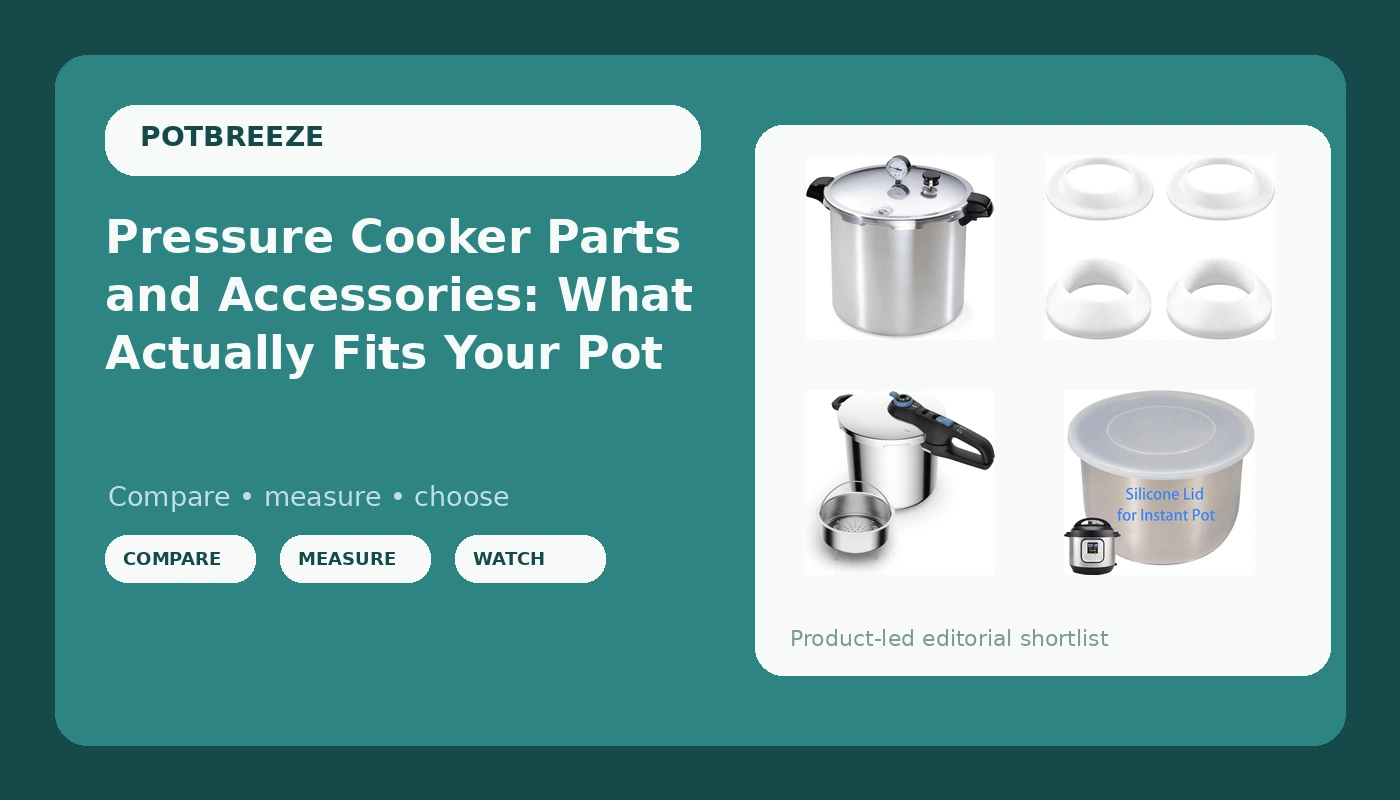
Pressure cookers rarely die of old age. They die of a hardened gasket, a lost lid, or a replacement part that looked close enough and was not. That is why pressure cooker parts and accessories deserve their own buying conversation instead of a footnote at the bottom of a recipe post. If your kitchen holds a stovetop canner, a stainless steel stovetop cooker, or an electric model with a removable inner pot, you are shopping in three different parts ecosystems, and the packaging rarely makes that clear. What follows covers four items worth understanding: a 23-quart canner and cooker, an 8.5-quart induction-rated stainless steel stovetop cooker, a silicone lid sized for 5 and 6 quart Instant Pot inner pots, and a universal basin drain gasket set that serves as a blunt reminder of how specific sealing parts really are.
Related: Stovetop vs Electric Pressure Cookers: Which One Fits Your Weeknight →
Quick answer
The part that fits is the part that matches your cooker's make, model, and size. Capacity and material tell you what a cooker is for: the Presto 01781 is a 23-quart canner and cooker built for large batches, while the T-Fal Secure Trendy is an 8.5-quart stainless steel stovetop cooker rated for induction. The silicone lid is a cover for 5 and 6 quart Instant Pot inner pots, not a pressure lid. And the universal basin drain gasket set is a bathroom sink part; it belongs in this conversation only as a warning that silicone rings are model-specific and that a non-cooker gasket should never go into a pressure cooker.
Four useful options
| Model | Best fit | What stands out |
|---|---|---|
| Presto 01781 23-Quart Pressure Canner and Cooker | Large-batch canning and big-household cooking on a stovetop | 23-quart capacity in a single canner-and-cooker body |
| Drainage Seal, Universal Basin Drain Gasket Replacement Parts | Bathroom sink drain repair | Thickened silicone ring with top and bottom washers, two sets |
| T-Fal Secure Trendy Stainless Steel Pressure Cooker, 8.5 qt, Induction | Everyday stovetop pressure cooking, including induction tops | Stainless steel body, 8.5 qt capacity, induction rating |
| Silicone Lid for Instant Pot 6 QT & 5 QT, 9.8IN | Covering and storing food in a 5 or 6 quart Instant Pot inner pot | 9.8-inch reusable silicone cover |
Large-batch option: Presto 01781 23-Quart Pressure Canner and Cooker
The appeal here is volume. A 23-quart canner and cooker is built for the kind of cooking that fills a freezer: tomato sauce in August, stock from a holiday bird, chili for a crowd, jars of preserves in a long afternoon session. The trade-offs are everything that comes with size. A pot this big is heavy when full, it needs a burner wide enough to heat the base evenly, and it claims real cabinet or pantry space. Stovetop cooking also asks more of you than an electric model does, because you manage the heat, watch the regulator, and decide when to move the pot off the burner. If you have never used a stovetop cooker, this is not the place to learn. If you already can or you feed a large household, the capacity is the entire point.
Replacement gasket set: Drainage Seal, Universal Basin Drain Gasket Replacement Parts
It would be easy to skim the words silicone sealing ring and assume this belongs inside a pressure cooker lid. It does not. This set is sized and shaped for a bathroom sink drain assembly, and a drain gasket does a completely different job than a cooker gasket. It seals against water at low pressure inside a drain body, not against steam at pressure inside a locked lid. Putting a non-cooker gasket into a pressure cooker is a safety problem, not a money-saving shortcut, and no amount of silicone makes a wrong part right. It earns a place on this list because it illustrates the rule that governs every purchase on this page: sealing parts are model-specific. Measure, find your model number, and buy the gasket the manufacturer lists for your cooker.
Induction stovetop option: T-Fal Secure Trendy Stainless Steel Pressure Cooker, 8.5 qt, Induction
Stainless steel matters for two reasons. It does not react with acidic food the way bare aluminum can, and it is what makes an induction rating possible in the first place, since induction burners need a magnetic base to work at all. The 8.5-quart size is the practical middle ground for a household cooking dinner most nights: enough room for a whole chicken, a pot of beans, or a batch of stew without the footprint of a canner. The trade-offs are the usual stovetop ones. You supply the heat and the timing, the lid has a regulator you learn to read, and there is no keep-warm setting waiting for you at the end. On the other side of the ledger, a stovetop cooker typically reaches pressure faster than an electric model and does not need counter space or an outlet.
Inner pot lid: Silicone Lid for Instant Pot 6 QT & 5 QT, 9.8IN
This is the accessory people buy after the first week, once they realize the inner pot is the best mixing bowl, storage container, and serving dish in the kitchen and the stock lid is in the dishwasher again. A silicone cover turns that pot into something you can slide into the fridge without decanting the contents into another container. Two things are worth keeping straight. First, it is a cover, not a pressure lid: it does not lock, it does not hold pressure, and it should never be on the pot during a pressure cycle. Second, fit is by diameter and pot size, so the 9.8-inch version is aimed at 5 and 6 quart inner pots. If you own a different size, measure the rim before ordering.
Prices and availability may change. Confirm that a part matches your cooker's model and size before ordering, and never substitute a non-cooker gasket or a non-pressure lid in a pressure cooking cycle.
Why sealing rings and gaskets are model-specific
The gasket is the part that makes pressure possible. It sits in the lid, flexes against the pot rim, and holds steam in so the cooker can build pressure at all. Silicone absorbs odors from curry, chili, and garlic, and it also hardens over time. A hardened ring stops sealing, and you notice because the cooker takes longer to come to pressure or never quite gets there. Replacement is a consumable purchase, not a repair, which is why a cooker whose gasket cannot be bought separately is effectively disposable.
The catch is that gaskets are cut to a specific lid diameter, thickness, and channel shape. Two rings that look identical on a phone screen can differ by a few millimeters, and a few millimeters is the difference between a seal and a steam leak. Model number beats product photo every time. Before you buy any cooker, check that the manufacturer sells its gasket on its own.
Stovetop and electric cookers need different parts
A stovetop cooker is one body with one locking lid, a regulator or vent, a gasket, and usually a rack or trivet. An electric cooker is a housing, a removable inner pot, a separate pressure lid with its own gasket and steam release valve, and often a second non-pressure lid for slow cooking. Parts do not cross over. An inner pot cover is not a pressure lid, and a canner gasket is not an electric model's gasket.
Capacity is measured differently too. On a stovetop cooker, the quart figure describes the whole body. On an electric model, it describes the inner pot, and usable volume is smaller than the number on the box because of the maximum fill line. That is why an 8.5-quart stovetop cooker and a 6-quart electric cooker can both feed the same family. Here is the order that avoids returns:
- Find the model number stamped on the base or back of the cooker, not on the box.
- Decide what the part is for: pressure sealing, covering, or storing.
- Match the size spec, meaning capacity in quarts and, for lids, the diameter in inches.
- Confirm the part is listed for your cooker by the manufacturer, or matches the exact spec.
- Buy a spare gasket if it is sold separately, so a failed seal does not bench the cooker for a week.
Keeping a pressure cooker running through the week
- Wash gaskets by hand, skip harsh detergents and high heat, and let them air dry fully before the lid goes back on.
- Store the lid upside down on the pot or off the cooker entirely so the gasket is not compressed for months at a time.
- Keep one spare gasket on hand, and label it if you own more than one cooker, because rings are not interchangeable.
- Use a silicone inner pot cover for fridge storage and serving, and keep the pressure lid out of the refrigerator.
- Measure before ordering anything, especially rings and lids, and match the size in the product name to your own pot.
Which option should you choose?
Choose the Presto 01781 23-Quart Pressure Canner and Cooker when your cooking happens in very large batches or you can, freeze, and preserve in volume. Choose the T-Fal Secure Trendy Stainless Steel Pressure Cooker, 8.5 qt, Induction when you want everyday stovetop pressure cooking, cook on an induction top, and prefer stainless steel. Choose the Silicone Lid for Instant Pot 6 QT & 5 QT, 9.8IN when you own a 5 or 6 quart Instant Pot and want to store or serve food straight from the inner pot. Choose the Drainage Seal universal basin drain gasket set when the job is a bathroom sink drain repair, and not before.
None of these listings tells you whether a part fits your specific cooker. Only the model number and the manufacturer's part documentation can do that, and no product photo substitutes for measuring the lid or ring you are replacing.
The bottom line
Pressure cooker parts and accessories come down to fitment and function. Capacity and material decide what a cooker can do: 23 quarts for canning and big batches, 8.5 quarts of stainless steel for induction stovetop cooking. What the cooker needs from you is a gasket that matches its lid exactly, a lid that is used only for covering and storing, and a clear line between cooker parts and everything else. Buy the part that matches the model number, keep a spare gasket if one is sold separately, and treat every sealing ring as a specific component rather than a universal one.